The Virtual Boy: Nintendo’s 3D Experiment and Why It Failed
Nintendo's red-and-black 3D console lasted barely a year. How the Virtual Boy worked, why it failed and why collectors find it fascinating today.
Nintendo has released some of the most successful hardware in the history of video games, which makes its rare failures all the more interesting. The Virtual Boy, launched in 1995, is the most famous of them. It promised three-dimensional gaming years before stereoscopic 3D became a mainstream feature, and it came from Gunpei Yokoi, the engineer behind the Game & Watch and the Game Boy. Yet it was discontinued in Japan within about five months and lasted only about a year in North America.
The Virtual Boy’s story is not just one of a bad idea. It is a story of an unusual display technology, compromises forced by cost and timing, and a product caught between being a home console and a portable. That combination explains both why it failed and why it has a devoted following today.
Gunpei Yokoi and a Licensed Display
By the early 1990s, Gunpei Yokoi was general manager of Nintendo’s R&D1 division and had built a reputation on simple, inexpensive hardware used in clever ways. His Game Boy, covered in our Game Boy history, had shown that modest technology could beat flashier rivals.
The Virtual Boy’s core technology came from outside Nintendo. Reflection Technology, Inc. (RTI), a company in Massachusetts, had developed a display technology called Scanned Linear Array, used in a head-mounted prototype display called the Private Eye. Instead of a full screen of pixels, it used a single column of LEDs and a vibrating mirror to sweep an image across the viewer’s field of vision. Nintendo licensed the technology exclusively, and Yokoi championed it inside the company.
Development took about four years under the codename VR32. Early ambitions, including head tracking, were dropped along the way, and the project was scaled down as Nintendo shifted resources to its next home console, the Nintendo 64 (see our Nintendo 64 history). Shigeru Miyamoto had minimal involvement in the Virtual Boy’s development.
How the Display Worked
The Virtual Boy’s display is the most interesting part of the machine. Looking into the eyepiece, players see a separate image for each eye, which creates a stereoscopic sense of depth.
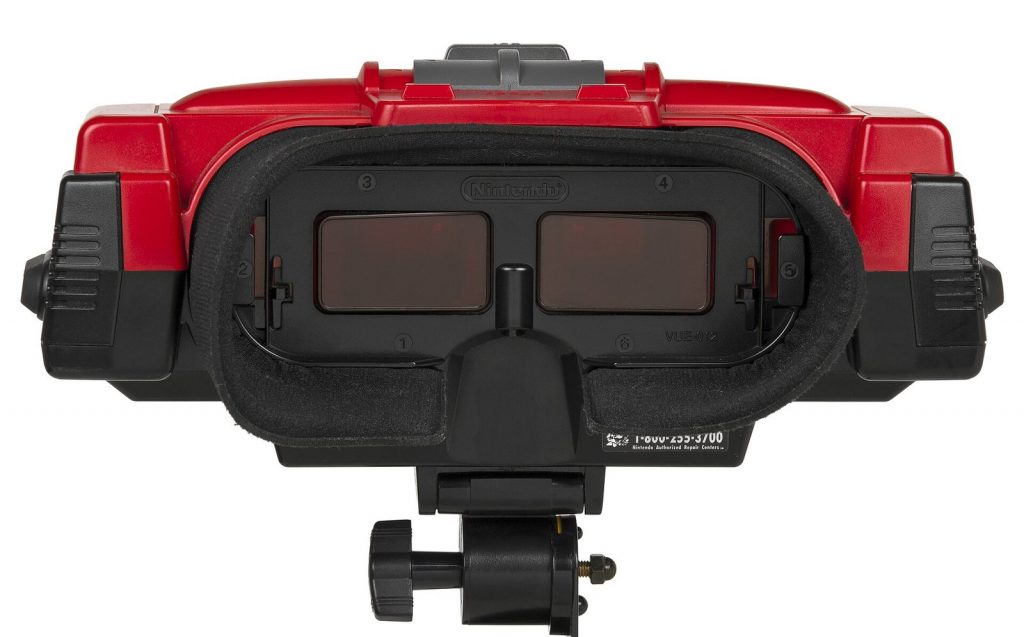
- Two displays. Each eye has its own image, 384 by 224 pixels, with four shades of red.
- Scanning LEDs. Rather than a flat screen, each eye’s image is produced by a vertical array of 224 red LEDs, one pixel wide. An oscillating mirror sweeps that column across the field of view fast enough that the eye perceives a full image.
- Mechanical motion. The mirrors move constantly, which produces a faint hum while the system runs. The display refreshes at roughly 50 Hz.
- True stereoscopy. Because the two eyes receive slightly different images, objects can appear closer or farther away, similar in principle to a stereoscope.
Why everything is red
The red-on-black image is the Virtual Boy’s most recognizable trait. The reason was cost and practicality. Red LEDs were cheap and effective at the time, while blue LEDs were expensive, ruling out full color. Nintendo said a color display would have been too expensive and would have produced unstable, “jumpy” images. Yokoi himself argued that red used less battery power and was easier to recognize. The result was a distinctive but monotonous look that many players found tiring.
Launch: July and August 1995
The Virtual Boy launched in Japan on July 21, 1995, and in North America on August 14, 1995, at a price of about $180. It was also released in Brazil, but never in PAL regions such as Europe and Australia. In North America, Mario’s Tennis was the pack-in game, and early titles included Red Alarm, Teleroboxer and Galactic Pinball.
Neither portable nor home console
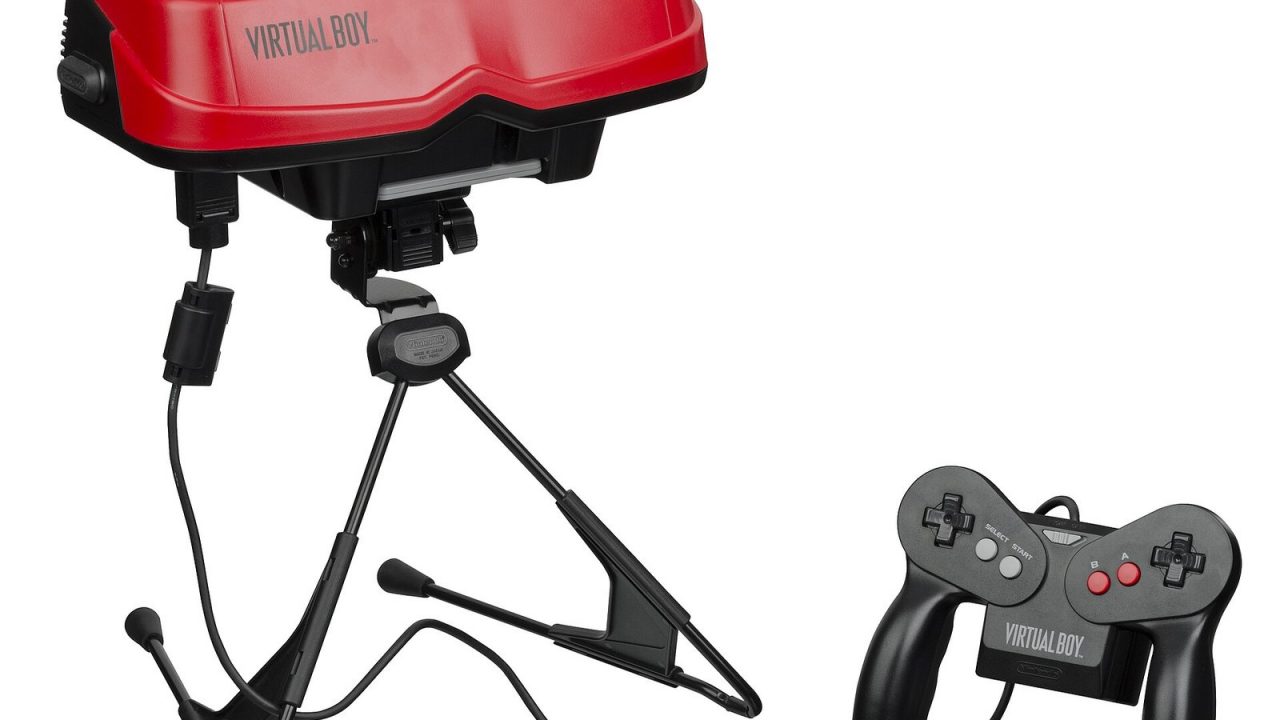
Marketing positioned the Virtual Boy as a new kind of experience, but its physical design created a problem. It is not a head-mounted display; it rests on a tabletop stand, and the player leans forward to press their face against the eyepiece. That design was partly about safety: a stationary tabletop unit followed a recommendation from the Schepens Eye Research Institute, and a promised standing harness was never released.
The result was a machine that could not be played comfortably on the go, like a Game Boy, and could not be shared with others watching a TV, like a home console. Only one person could see the game at a time. It ran on six AA batteries or an optional adapter, and its unusual M-shaped controller had two directional pads intended to give games extra control options.
Health Warnings and Player Comfort
The Virtual Boy launched during a period of public concern about the effects of 3D displays and virtual reality on players, especially children. Nintendo built safeguards into the system. Games could prompt players to take breaks, with an optional automatic pause every 15 to 30 minutes to reduce eye strain. Warnings addressed the potential effects on young children’s vision.
Players nonetheless reported headaches, dizziness and eye strain, and the red monochrome image added to the fatigue. Warnings and automatic pauses, while responsible, also sent a message that the product might not be entirely comfortable to use. For a game system, that was a difficult message to overcome.
A Small Library and a Quick Exit
Only 22 games were released for the Virtual Boy: 19 in Japan and 14 in North America, with overlap between the two. Many showed off the 3D effect in interesting ways, but there was no system-selling title on the scale of Tetris for the Game Boy or a major new Mario adventure.
Sales were weak from the beginning. Nintendo discontinued the Virtual Boy in Japan on December 22, 1995, only five months after launch. The last official game, 3D Tetris, was released on March 22, 1996, and the system was discontinued in North America in August 1996. According to figures reported by the Japanese magazine Famitsu in June 1996, worldwide sales reached about 770,000 units, including about 140,000 in Japan.
Why the Virtual Boy Failed
Historians and former Nintendo staff usually point to a combination of factors rather than a single cause:
- The red display. The single-color image looked dated next to color consoles and caused eye fatigue for many players.
- An awkward form factor. A tabletop unit that one person used at a time fit neither portable nor living-room play.
- Price. At about $180, it cost as much as or more than many home consoles of the time without offering a comparable library.
- A thin library. With 22 games in total and no must-have title, there was little reason to buy in.
- Rushed and downscaled development. Nintendo’s attention was focused on the upcoming Nintendo 64, and features like head tracking had been dropped.
- Health concerns. Warnings and reported discomfort made the product harder to recommend to parents.
Miyamoto later described the Virtual Boy as a novelty that should not have carried the Nintendo license so prominently, an unusually frank assessment from inside the company. In 2007, GamePro ranked it fifth on a list of the worst-selling consoles.
Yokoi After the Virtual Boy
It is often said that the Virtual Boy ended Yokoi’s career at Nintendo. The facts are more nuanced. Yokoi left Nintendo on August 15, 1996, after 31 years at the company, following the Game Boy Pocket. Nintendo called the timing of his retirement “absolutely coincidental,” and a colleague said Yokoi had long planned to retire around the age of 50. Journalist David Sheff’s account holds that Yokoi never intended the Virtual Boy to be released in its final form and that Nintendo rushed it out to focus on the Nintendo 64.
Yokoi and several colleagues founded a company called Koto, where he led development of Bandai’s WonderSwan handheld. He died on October 4, 1997, after being struck by a passing car following a minor collision on an expressway; the WonderSwan was released in 1999. His legacy rests on far more than one product: his philosophy of “lateral thinking with withered technology,” using mature, affordable technology in new ways, shaped the Game & Watch and the Game Boy, and arguably later Nintendo hardware too.
Legacy: Nintendo’s Long Road Back to 3D
The Virtual Boy did not end Nintendo’s interest in stereoscopic 3D. In 2011 the company released the Nintendo 3DS, which offered glasses-free 3D on a color screen and could be played normally like any handheld. Where the Virtual Boy forced players into a fixed viewing position, the 3DS let them adjust or switch off the effect.
Nintendo also revisited the Virtual Boy itself. On September 12, 2025, Nintendo announced that Virtual Boy games would come to Nintendo Switch Online for members with the Expansion Pack tier, played using a dedicated viewer accessory for the Switch, offered in a plastic version and a cheaper cardboard version. The first games became available on February 17, 2026. As of 2026, this is the official way to play a selection of Virtual Boy games on current hardware; for other options covering classic systems, see our guide to legal ways to play classic games.
The Virtual Boy as a Collectible
Low sales and a short lifespan have made the Virtual Boy a curiosity that many collectors want on their shelves. A few practical points are worth knowing:
- Test before buying. The scanning-mirror display is a precise mechanical system, so ask for evidence that both eyes’ images display correctly. Internal repairs are delicate and best left to experienced technicians.
- Completeness matters. The stand, the controller with its battery pack and the original packaging all contribute to a complete system, and boxed units are prized.
- Regional versions. Japanese and North American releases have different library selections, and some games were only released in Japan.
- Limited library. With 22 games in total, a complete collection is an achievable goal for dedicated collectors, which is part of the appeal.
Today the Virtual Boy occupies an unusual place in gaming history: a commercial failure that is nonetheless remembered with affection. It was an honest experiment with a genuinely novel display, and it showed both the promise and the problems of 3D gaming long before the technology matured.