Pac-Man (1980): The History of Namco’s Arcade Icon
The story of Pac-Man: Toru Iwatani's design goals, the Puck-Man name change, the four ghosts, level 256, Pac-Man Fever, Ms. Pac-Man and the Guinness record.
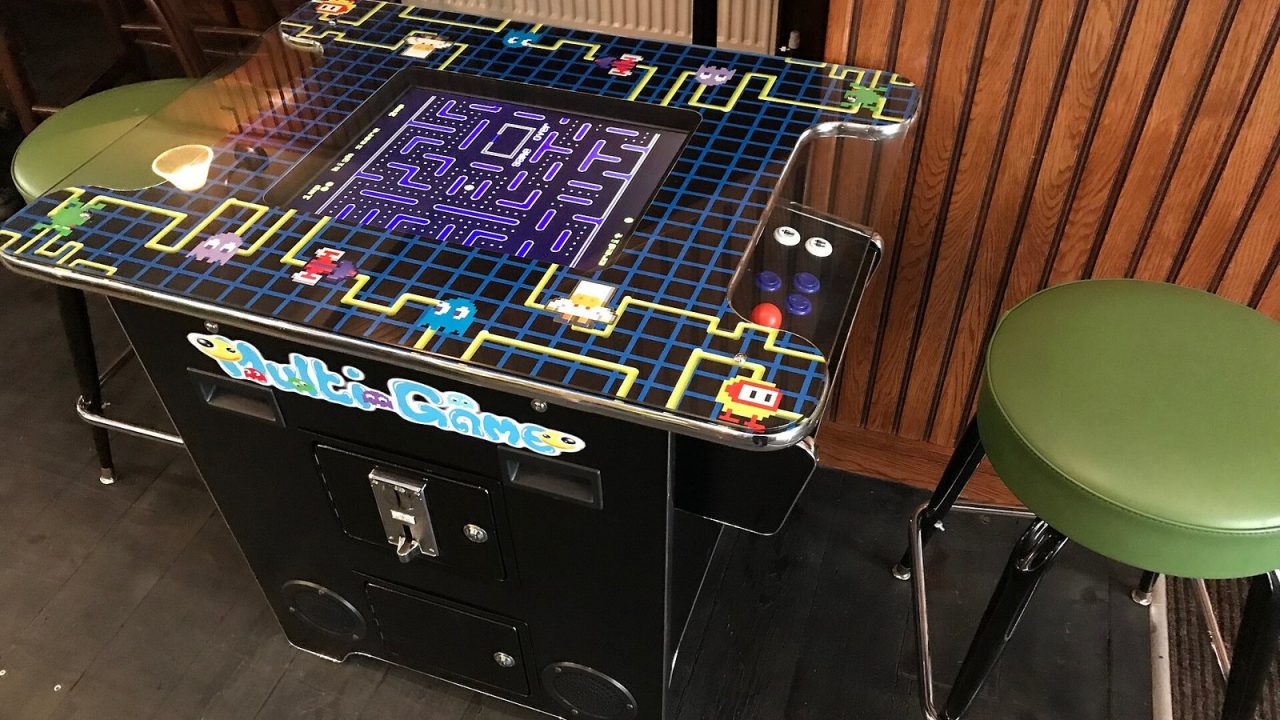
In 1980, most arcade games were about shooting things. Then Namco released a game about a round yellow character eating dots in a maze while four colorful ghosts chased him around. Pac-Man became one of the most successful arcade games ever made and one of the first video game characters to become a true pop-culture celebrity, with songs, cartoons and hundreds of products bearing his face.
This article covers how Pac-Man was designed, why its name changed, how the ghosts behave, the famous level 256, the merchandise craze, the unusual origin of Ms. Pac-Man and the much-criticized Atari 2600 version.
Toru Iwatani’s Design Goals
Pac-Man was created by Toru Iwatani, a young designer at Namco, who led a team of nine other employees. Development began in early 1979 and took around 17 months.

Iwatani had a clear aim: arcades of the time were dominated by violent space shooters and were largely male spaces. He wanted to make a nonviolent, cheerful game that would appeal to women and couples as well. He chose eating as the central action, reasoning that it was something everyone could relate to, and he has explained the focus on food partly by noting that many women he knew liked sweets.
The character’s shape has its own story. Iwatani often said that Pac-Man was inspired by a pizza with a slice missing. In a 1986 interview, he said that was only partly true; the design also came from simplifying the Japanese character for “mouth” (口, kuchi). The pizza story is not false, but it is not the whole explanation either.
The gameplay is easy to grasp. Pac-Man moves through a maze eating dots. Four ghosts roam the maze, and touching one costs a life. Eating one of four large “power pellets” turns the ghosts blue for a short time, letting Pac-Man eat them for bonus points. Clearing every dot advances to the next round, and fruit bonuses appear in the center of the maze. Short comic intermissions between some rounds added personality, an early example of story-like scenes in an arcade game.
From Puck-Man to Pac-Man
The game was released in Japan in 1980 under the name Puck Man, with location testing beginning on May 22, 1980, in Shibuya, Tokyo. The name came from the Japanese word “paku paku,” which describes the sound of eating or a mouth opening and closing.
When Namco prepared the game for North America, there was a problem. Executives feared that vandals would scratch the “P” on cabinets into an “F,” turning the name into an obscenity. The game was renamed Pac-Man for the American release, which was handled by Midway Manufacturing in October 1980. Midway initially produced a modest run of machines and soon had to ramp up dramatically.
Blinky, Pinky, Inky and Clyde
One reason Pac-Man felt alive was that the four ghosts did not all behave the same way. Each had its own personality, reflected in both its English and Japanese names:
| Ghost (color) | Japanese nickname | Behavior |
|---|---|---|
| Blinky (red) | Oikake (“chaser”) | Pursues Pac-Man directly |
| Pinky (pink) | Machibuse (“ambusher”) | Tries to get ahead of Pac-Man and cut him off |
| Inky (cyan) | Kimagure (“fickle”) | Uses a more complicated, less predictable approach |
| Clyde (orange) | Otoboke (“playing dumb”) | Alternates between chasing and wandering off depending on his distance from Pac-Man |
In the original English release, the ghosts’ “character” names were Shadow, Speedy, Bashful and Pokey, with Blinky, Pinky, Inky and Clyde as their nicknames.
The combination of behaviors meant the ghosts often trapped Pac-Man between them without any one ghost being especially clever. Because the game was deterministic, the same inputs always produced the same ghost movements. Dedicated players learned “patterns,” precise routes through each maze that avoided the ghosts entirely, and books of patterns sold well in the early 1980s.
Level 256: The Split Screen
Pac-Man has no ending in the usual sense. The rounds simply repeat with increasing difficulty. But if a player survives long enough to reach the 256th level, the game breaks.
On level 256, the left half of the maze appears normally, but the right half is filled with a jumble of garbled symbols, letters and numbers. Wikipedia attributes this to an integer overflow: the game stores the level number in a way that can only count up to 255, and when it rolls over, the code that draws the level’s fruit indicators runs out of control and overwrites half the screen. The corrupted half cannot be cleared properly, so the level cannot be completed under normal play. Players call it a “kill screen.”
Reaching the split screen became the ultimate goal of top players. The maximum possible score, achieved by eating every dot, power pellet, ghost and fruit on every level up to 256, is 3,333,360 points. Billy Mitchell achieved the first publicly verified perfect score on July 3, 1999. His records later became the subject of a dispute stemming from an investigation into his Donkey Kong scores; Guinness World Records removed and then, in June 2020, reinstated his records.
A Phenomenon: Sales and Records
Pac-Man was Japan’s highest-grossing arcade game of 1980 and the United States’ highest-grossing arcade game of 1981. In the US, more than 100,000 machines sold within a year, and around 400,000 by 1982, according to figures cited by Wikipedia. Estimates of its total arcade earnings vary widely, but they are measured in billions of dollars.
Guinness World Records recognized Pac-Man as the most successful coin-operated arcade game, citing 293,822 machines installed worldwide in a record set in 2005 and formally presented in 2010. As with most golden-age figures, the different numbers reflect different ways of counting (machines manufactured, sold or installed), so they should not be compared too literally.
For the wider picture of arcades at the time, see our article on the golden age of arcade games.
Pac-Man Fever: The Merchandise Boom
Pac-Man was one of the first video game characters to become a mainstream brand. By 1982, hundreds of different products had been licensed, from lunchboxes and board games to breakfast cereal and clothing.
- “Pac-Man Fever.” A novelty song by Buckner & Garcia, released in 1981, reached number 9 on the Billboard Hot 100.
- Television. Hanna-Barbera produced a Pac-Man animated series that aired on ABC from 1982 to 1983.
- Everyday products. The character appeared on everything from toys to bedsheets, which helped introduce video game characters to people who had never set foot in an arcade.
The merchandise wave showed the industry that a game character could be valuable far beyond the game itself, a lesson that later shaped how Nintendo and Sega promoted Mario and Sonic.
Ms. Pac-Man: An Unofficial Mod Turned Official
Ms. Pac-Man has one of the strangest origin stories in arcade history. It began as Crazy Otto, an unauthorized enhancement kit for Pac-Man created by programmers at General Computer Corporation (GCC), a Massachusetts company. Enhancement kits that modified popular arcade games were common at the time.
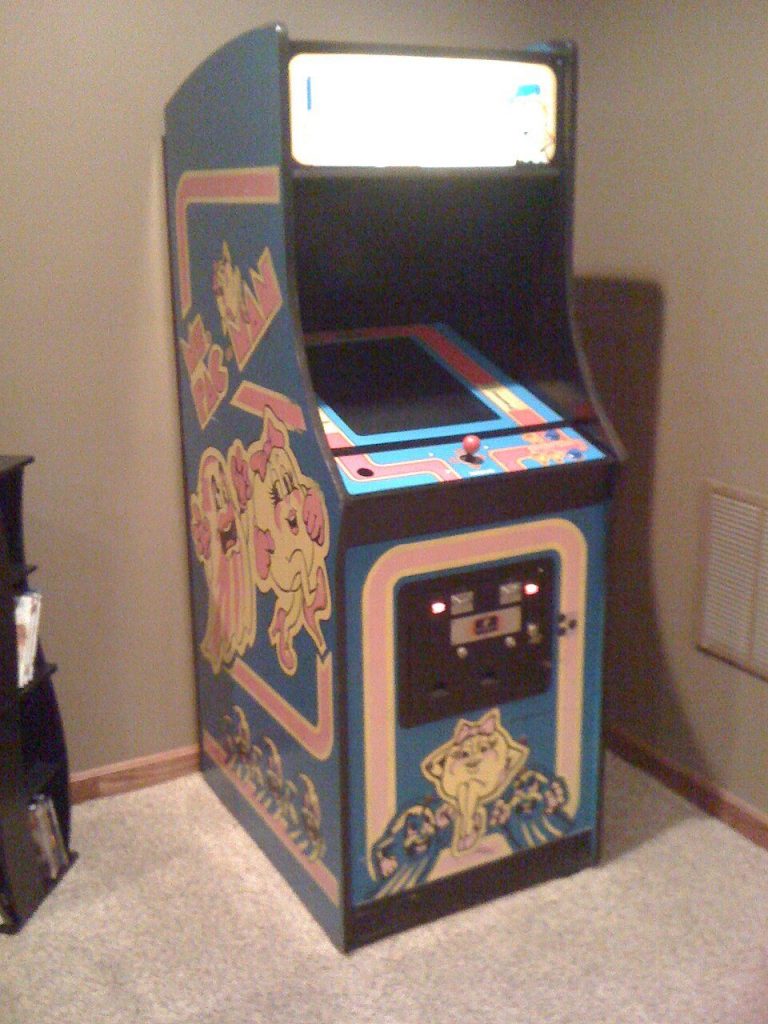
GCC had previously settled a dispute with Atari over a kit for Missile Command, and the settlement barred it from selling conversion kits without the original manufacturer’s consent. So instead of selling Crazy Otto directly, GCC took it to Midway, which bought the rights and worked with GCC and Namco to turn it into an official sequel. After trying names such as Super Pac-Man, Pac-Woman and Miss Pac-Man, the game became Ms. Pac-Man, with a female lead reflecting the original game’s popularity with women.
Ms. Pac-Man debuted in February 1982 and improved on the original in several ways:
- Four different mazes with different color schemes.
- Extra escape tunnels in several mazes.
- Ghosts with semi-random movement, which made memorized patterns much less reliable.
- Fruit that bounces around the maze rather than sitting in the center.
- New intermissions telling the story of Pac-Man and Ms. Pac-Man’s relationship.
Many players consider it better than the original. Its unusual origins have had a long tail: royalty rights connected to GCC have been the subject of legal disputes as recently as 2019 and 2020, and since 2022 newer Namco releases have used a different character, Pac-Mom, in her place, although Bandai Namco has not given an official reason.
The Atari 2600 Port
Atari released a home version of Pac-Man for the Atari 2600 in March 1982. It was a huge commercial success, the best-selling home video game of 1982. It was also widely panned.
The 2600 could only display a limited number of moving objects, so the four ghosts flickered heavily, each appearing only on some frames. The maze was simplified, the dots became thin rectangles called “wafers,” the colors and sounds bore little resemblance to the arcade game, and the famous intermissions were gone. Later critics have called it one of the worst arcade conversions ever made.
Atari produced more cartridges than it could sell, and the disappointment of buyers who expected the arcade experience is often cited as one factor in declining consumer confidence before the North American market collapsed, as discussed in our article on the video game crash of 1983. It is a reminder that even a hugely popular game could be damaged by a weak conversion.
Legacy
Pac-Man proved that video games did not need to be about combat to be successful, broadened the arcade audience and created one of gaming’s first mascot characters. It spawned a long series of sequels, spin-offs and re-releases that continues today, and it remains a fixture of official collections. Its maze, its ghosts and its “waka waka” sound are recognized around the world, more than four decades after a pizza with a slice missing, or perhaps a simplified character for “mouth,” became a gaming icon.