The Video Game Crash of 1983: What Happened and Why It Mattered
Why the North American console market collapsed between 1983 and 1985, what caused it, and how the crash shaped Nintendo's careful launch of the NES.

In the early 1980s video games looked unstoppable. Arcades were packed, the Atari 2600 sat under millions of televisions, and new consoles and cartridges arrived almost every month. Within a couple of years, much of that business had evaporated in North America. Retailers cleared their shelves, publishers folded, and many observers concluded that home video games had been a passing fad.
That collapse, usually called the video game crash of 1983, even though it played out from late 1982 into 1985, is one of the most important turning points in gaming history. It ended Atari’s dominance, shifted the center of the console business to Japan, and shaped the cautious, tightly controlled way the Nintendo Entertainment System was introduced. Here is what happened, why, and what changed afterwards.
The Boom Before the Bust
To understand the crash you have to understand how crowded the market had become. The Atari VCS, later renamed the Atari 2600, had been on sale since 1977 and was the dominant home console. By 1982 it faced a field of rivals: Magnavox’s Odyssey², Mattel’s Intellivision, the ColecoVision, Atari’s own 5200 and the vector-graphics Vectrex. (For where these machines sit in the bigger picture, see our guide to console generations.)
The ColecoVision was the first serious threat to Atari, but the 2600 remained far ahead. According to figures cited in Wikipedia’s account of the crash, the 2600 held around 58 percent of the hardware market in 1982 against roughly 17 percent for Coleco. Meanwhile, publishers, retailers and investors were treating games as a guaranteed growth industry. That confidence would turn out to be badly misplaced.
Cause One: Too Many Consoles, Too Much Product
The first problem was simple oversupply. Several incompatible consoles competed for the same households, and each needed its own games, accessories and shelf space. Analysts at the time warned that production was growing faster than demand; Wikipedia’s article cites a 1983 Goldman Sachs estimate that manufacturing output had risen far more quickly than consumer demand.
Atari itself contributed to the problem. Its home version of Pac-Man for the 2600, released in March 1982, became the year’s best-selling home video game, but Atari had produced even more copies than it could sell, and many players were disappointed by flickering ghosts and graphics that looked little like the arcade original. Warner later acknowledged that the port’s strong sales despite its quality made Atari overconfident about its next big licensed releases. E.T. the Extra-Terrestrial, rushed out for the 1982 holiday season, became another symbol of overproduction. When Atari reported in December 1982 that it had missed its holiday sales expectations, the news hit the stock prices of Warner Communications, Atari’s parent company, and other game firms.
Cause Two: A Flood of Low-Quality Third-Party Games
The second cause came from a success story. Activision, founded in 1979 by former Atari programmers, proved that an independent company could make and sell games for someone else’s console. Hits such as Pitfall! showed how profitable that could be.
The problem was that the 2600 had no technical way to stop anyone from publishing for it. Dozens of companies with no game experience rushed in, including firms better known for food, toys or films. Activision co-founder David Crane later described many of these newcomers as producing some of the worst games imaginable. Consumers who bought a bad cartridge for full price had little way to know in advance whether the next one would be any better, and trust in the whole category eroded.
Cause Three: Home Computers Undercut Consoles
At the same moment, home computers became affordable. A bitter price war broke out between Commodore and Texas Instruments: Commodore cut the price of the VIC-20 and the Commodore 64 aggressively, and TI cut the TI-99/4A until it eventually left the home computer market altogether.
The pitch to families was persuasive. A computer could play games, but it could also be used for typing, programming and schoolwork. Why buy a machine that only played games? Software on cassette and floppy disk was also cheaper to produce than cartridges and easy to copy, which put further pressure on cartridge prices.
Cause Four: Retailers Lose Confidence
The final blow landed in the stores. Retailers had ordered heavily and soon found themselves with stockrooms full of games nobody wanted. Many of the small publishers that had flooded the market went out of business and could not take back unsold inventory or issue refunds. Stores responded by slashing prices; games that had sold for around $35 ended up in bargain bins for a few dollars.
Clearance pricing made matters worse. When dozens of older games sold for a fraction of the price of new releases, it became even harder for publishers to sell new cartridges at full price. Many retailers concluded that video games were a fad and reduced or removed their game sections. That reluctance lasted until the middle of the decade and is arguably the most important part of the crash, because it meant that even a good new console would struggle to get onto shelves.
How Big Was the Collapse?
The most frequently quoted figures, cited in Wikipedia’s article from contemporary reporting, put North American home video game revenue at around $3.2 billion at its peak and around $100 million by 1985, a fall of roughly 97 percent. The article itself is inconsistent about whether the peak year was 1982 or 1983, so the numbers are best read as an indication of scale rather than precise accounting. Either way, a fall of that size is extraordinary for any consumer industry.
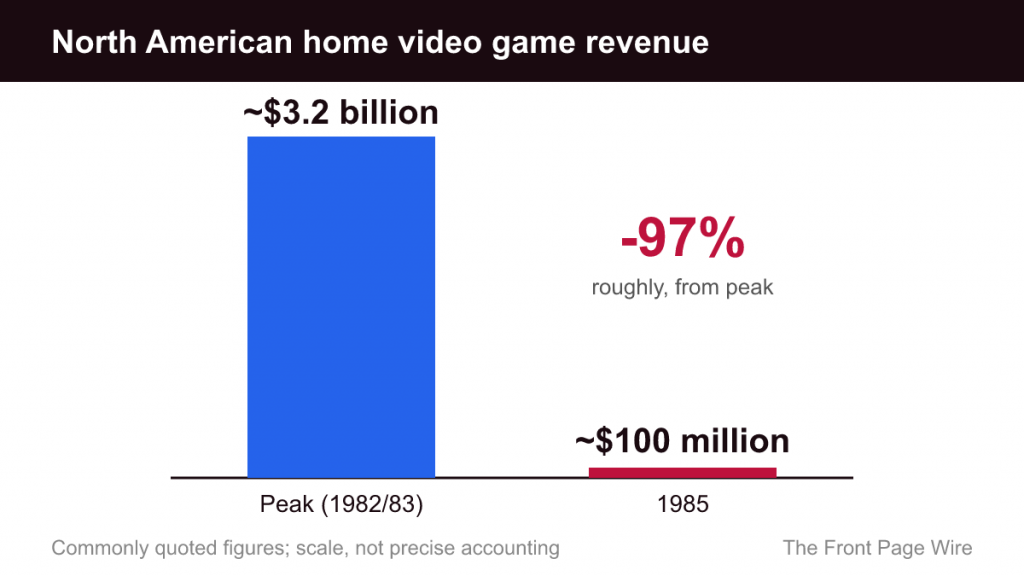
Individual companies tell the story more concretely:
- Atari reported losses of hundreds of millions of dollars in 1983, laid off a large share of its workforce and moved manufacturing overseas. In July 1984, Warner sold Atari’s consumer division to Jack Tramiel, the founder of Commodore.
- Mattel sold off its video game business, including the Intellivision, to a group led by one of its own executives.
- Magnavox withdrew from the console business.
- Many smaller publishers simply disappeared.
Arcades were also cooling at the same time, though that decline had its own causes and is often treated separately from the home console crash.
The Landfill: A Symbol, Briefly
In September 1983 Atari buried a large quantity of unsold stock in a landfill in Alamogordo, New Mexico. Over time the story grew into a legend about millions of E.T. cartridges being buried in the desert. A 2014 excavation confirmed that cartridges really were there, including E.T. and other titles, but the total recovered from the site was far lower than the most dramatic versions of the tale. We cover the dig and the myths around it in a dedicated article; for this story, what matters is that the landfill became a convenient symbol of the whole crash.

Japan and Europe: A Different Story
The crash was a North American event. Japan’s market was not directly harmed; the downturn was sometimes called the “Atari shock” there, and Japanese companies were preparing new hardware just as the American market fell apart. In July 1983, Nintendo launched the Family Computer (Famicom) in Japan, and Sega released its SG-1000 the same month. The Famicom went on to become a huge success at home over the following years.
Europe also escaped the worst of it, mainly because the European market was built around home computers such as the ZX Spectrum, Commodore 64 and Amstrad CPC. Cassette-based games remained cheap and plentiful there throughout the 1980s. In the UK, consoles did lose ground after 1983 and computers led the market for years afterwards.
Nintendo’s Cautious Entry Into America
The crash shaped how Nintendo approached North America. In 1983 Nintendo negotiated with Atari to distribute the Famicom in the United States, but the deal fell apart. Nintendo then planned to sell the system itself, first showing a version called the Advanced Video System at the Winter Consumer Electronics Show in January 1985.
The console that eventually launched looked very different and was presented with great care to avoid anything that reminded retailers of the crash:
- New vocabulary. It was the “Nintendo Entertainment System,” not a video game console. The hardware was a “Control Deck,” and the cartridges were “Game Paks.”
- A VCR-like design. Designers Lance Barr and Don James gave the NES a front-loading slot that resembled a video cassette recorder rather than a top-loading game console.
- A robot for toy stores. The Deluxe Set included R.O.B. (Robotic Operating Buddy) and the Zapper light gun, which helped position the product as a sophisticated toy.
- A careful rollout. The NES had a test launch in New York City on October 18, 1985, followed by Los Angeles in February 1986, and a nationwide release later in 1986. Nintendo also took on risk for retailers, reportedly offering to take back unsold stock.
Controlling Quality: Lockout Chips and Licensing
Nintendo’s most important lesson from the crash was that unchecked third-party publishing could poison a platform. The NES therefore included the 10NES lockout chip, which was designed to prevent unlicensed cartridges from running. Licensed publishers had to follow Nintendo’s rules, which included a limit on how many games they could release per year and requirements around exclusivity, while Nintendo’s “Official Nintendo Seal of Quality” told shoppers that a game had been approved.
These policies were controversial. Critics argued they gave Nintendo too much power over publishers and retailers, and Nintendo’s licensing practices later drew antitrust scrutiny in the United States, leading to a settlement with the Federal Trade Commission in 1991. But in the short term the strategy worked: retailers were willing to stock video games again, and the NES became the dominant console of its era.
Why the Crash Still Matters
The crash shaped the industry in several lasting ways:
- Platform holders control access. Approval processes, licensing fees and certification became standard across the console business, and they remain part of how consoles work today.
- Japan took the lead. For roughly the next decade and a half, Nintendo and Sega dominated home consoles, with Sony joining them in the mid-1990s. American hardware makers, including Atari, never regained their old position.
- Retail relationships matter. Unsold stock, returns and price protection became central concerns for every publisher.
- Quality perception is fragile. The crash showed that consumers can lose faith in an entire category when bad products are hard to distinguish from good ones.
It is also worth remembering what the crash was not. It did not end video games, and it barely touched Japan or Europe’s computer scene. PC and home computer gaming carried on in North America too. What collapsed was a specific business: the cartridge-based console market built around Atari and its imitators, with retailers who had learned the hard way to be skeptical.
Common Misconceptions
- “E.T. caused the crash.” It was one notorious example of overproduction and rushed development, but the causes were much broader: too many consoles, too many weak games, cheaper computers and nervous retailers.
- “The crash was worldwide.” It was overwhelmingly a North American phenomenon.
- “Nobody played games from 1983 to 1985.” People kept playing, often on home computers and on discounted cartridges. The collapse was in sales and retail support, not interest.
- “Millions of cartridges are buried in New Mexico.” The 2014 dig found far fewer than the legend claimed.