The Original PlayStation: How Sony Entered and Reshaped the Console Market
How a broken Nintendo deal, Ken Kutaragi's persistence and cheap CD-ROMs turned Sony's first console into the first to pass 100 million units.
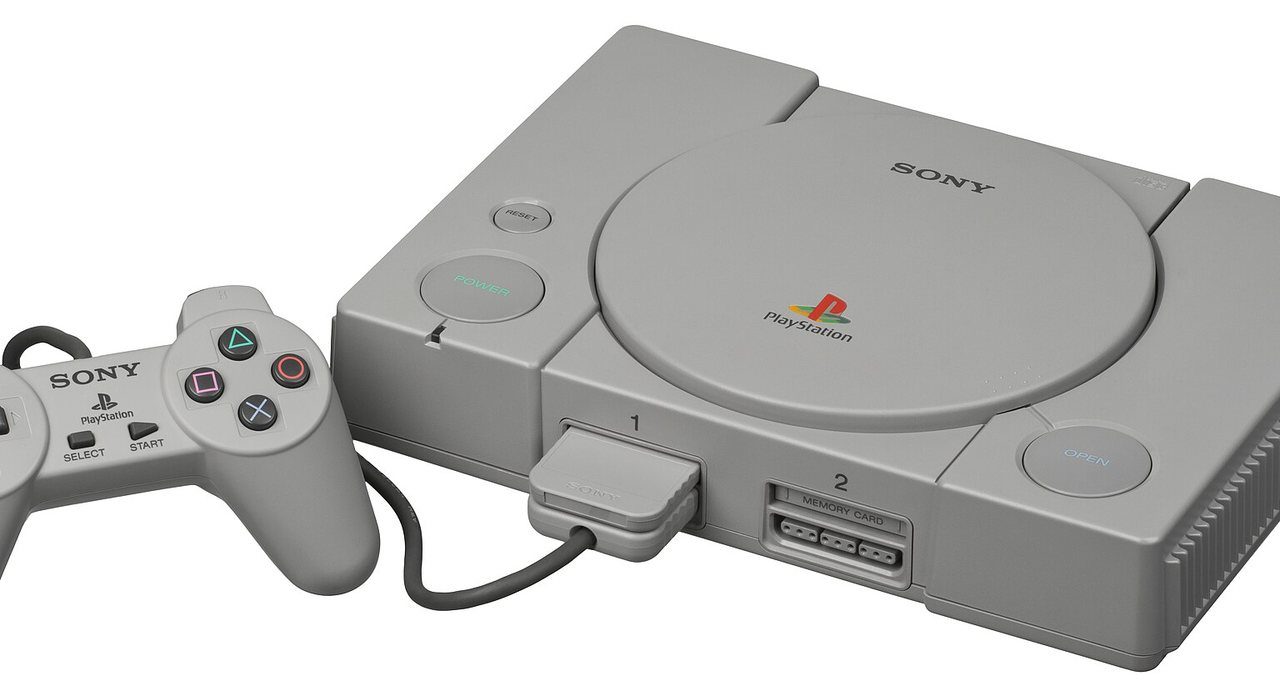
In the early 1990s, Sony was a giant of televisions, Walkmans and music, but in video games it was mostly a parts supplier. By the end of the decade it sold the best-selling console of its generation. Sony Interactive Entertainment reports cumulative sales of more than 102.4 million original PlayStation units (as of March 31, 2012), and it was the first home console platform to ship more than 100 million. How that happened involves a collapsed partnership with Nintendo, a determined engineer, a famous four-word press conference and a simple bet on the economics of compact discs.
The Nintendo Deal That Fell Apart
The PlayStation began as a Nintendo accessory. Sony engineer Ken Kutaragi, who had joined Sony’s research labs in the 1970s, designed the SPC700 sound chip used in the Super Nintendo. That project gave him a working relationship with Nintendo, and in the late 1980s Sony began developing a CD-ROM drive for the Super NES. Sony’s version was planned as a hybrid machine that could play both SNES cartridges and CDs, and it carried a name that would later become famous: “Play Station.”
The relationship broke down over the terms. Sony expected to keep significant control over the CD format, which Nintendo’s leadership, under president Hiroshi Yamauchi, was unwilling to accept. At the Consumer Electronics Show in June 1991, Sony publicly unveiled its SNES-compatible Play Station. The next day, Nintendo announced that it would work with Philips instead. The surprise announcement has often been described by journalists as one of the great betrayals in the industry’s history.
Negotiations did not end immediately. Reference sources report that a few hundred prototypes were produced and that the two companies even reached a further arrangement in early 1992. But Sony cut ties with Nintendo in May 1992 and redirected the work toward a standalone console of its own. Nintendo’s Philips-based CD add-on never materialized either; it was reportedly cancelled in 1993. Philips did gain the right to use some Nintendo characters on its own CD-i machine.
A surviving hybrid prototype surfaced in 2015 and was later confirmed to work, a reminder of how close the industry came to a different history.
Ken Kutaragi and Sony’s Decision to Go It Alone
Kutaragi, born in 1950, is widely called “the Father of the PlayStation.” Inside Sony, video games were not an obvious fit, and the idea of a Sony console had skeptics. Kutaragi argued that the work done for Nintendo should not be thrown away, and the project survived as an independent console with a new focus: real-time 3D graphics.

Sony publicly announced its entry into the console market on October 27, 1993. Its game business was organized as Sony Computer Entertainment, set up jointly by Sony and Sony Music Entertainment Japan. That music connection mattered more than it might seem. Sony Music already knew how to press and distribute compact discs at scale, and it understood the economics of a hit-driven entertainment business. Regional arms followed: Sony Computer Entertainment America was formed in May 1994 and its European counterpart in January 1995.
Sony also acquired the British studio Psygnosis, best known for Lemmings and later Wipeout. Reference sources credit Psygnosis with producing a large share of the console’s early Western catalog, giving Sony credible software at a time when it had no game library of its own.
The 1994 Japanese Launch and the 1995 Western Launches
The PlayStation went on sale in Japan on December 3, 1994, at ¥39,800. Its competition there was intense: Sega’s Saturn had launched just weeks earlier, in November 1994. One of the PlayStation’s early showcase titles was Namco’s Ridge Racer, an arcade racing conversion that demonstrated the machine’s 3D capability.
Technically, the PlayStation was built around a 32-bit MIPS R3000-family processor and dedicated hardware for drawing 3D polygons, paired with a double-speed CD-ROM drive. Developers generally found it more straightforward to program for 3D than the Saturn, whose dual-processor design was notoriously complicated. That ease of development would become one of Sony’s biggest advantages.
The Western launch dates were:
| Region | Launch date | Launch price |
|---|---|---|
| Japan | December 3, 1994 | ¥39,800 |
| North America | September 9, 1995 | US$299 |
| Europe | September 29, 1995 | — |
| Australia | November 15, 1995 | — |
E3 1995: “Two Ninety-Nine”
The most quoted moment in the PlayStation’s history happened at the first Electronic Entertainment Expo in Los Angeles in May 1995. Sega used its own presentation to announce that the Saturn was already shipping to some US retailers, months ahead of its planned launch, at a price of $399. The surprise launch was meant to seize the initiative.
Sony’s keynote came on May 11, 1995. Olaf Olafsson, head of Sony Computer Entertainment America, invited Steve Race, the company’s head of development, to the stage. Race walked up to the podium, said “Two ninety-nine,” and walked off. The PlayStation would cost $100 less than the Saturn. The moment is still cited as a lesson in how price can define a launch.
Sega’s early Saturn launch also caused friction with retailers who were left out of the initial shipments, which compounded the damage. We cover that side of the story in our history of the Sega and Nintendo rivalry and in the Saturn’s own history.
Why CD-ROMs Changed the Business for Publishers
The PlayStation’s biggest structural advantage was its storage medium. Cartridges were expensive to make, took time to manufacture, and, in Nintendo’s case, had to be ordered through Nintendo itself. A publisher who misjudged demand could be left with costly unsold inventory, or, just as damaging, could run out of stock during a hit and wait weeks for more.
CDs changed that calculation in several ways:
- Lower manufacturing cost. A pressed disc cost far less to produce than a cartridge full of ROM chips, so publishers risked less money per unit.
- Faster restocking. CD plants existed around the world, and discs could be produced in bulk quickly. A surprise hit could be reprinted fast.
- Cheaper games for players. Reference sources note that Sony could offer games at substantially lower prices than typical cartridge games.
- Much more space. A CD held far more data than the cartridges of the day, allowing pre-rendered video, recorded music and voice acting.
The trade-offs were load times and easier piracy, since discs were simpler to copy than cartridges. Sony responded with copy protection that checked for specially mastered discs, and the legal battles around unofficial software and emulation, such as Sony’s cases against Connectix and Bleem, are covered in our explainer on whether emulation is legal.
The most famous consequence of the storage gap was Square’s decision to develop Final Fantasy VII for the PlayStation instead of Nintendo’s cartridge-based Nintendo 64. Its large pre-rendered backgrounds and full-motion video sequences would have been impractical on a cartridge. Enix’s Dragon Quest VII, another series long associated with Nintendo platforms, also ended up on PlayStation. For Japanese players, those two moves signaled that the center of gravity had shifted.
Courting an Older Audience
Nintendo’s image in the early 1990s was firmly tied to families and children. Sony positioned the PlayStation differently. Its early marketing aimed at teenagers and young adults, on the reasoning that younger players would follow what older ones considered cool. Reference sources note that early buyers skewed toward adults, and the audience broadened as prices came down.
Sony’s European marketing in particular linked the console to club culture and nightlife, and games like Psygnosis’s Wipeout, with its licensed electronic music soundtrack, fit that image. The broader point was that games could be presented as mainstream entertainment for people in their twenties, not just toys.
The library supported that strategy. Alongside family-friendly mascots, the PlayStation became home to darker and more cinematic titles. Some of its most influential games include:
- Gran Turismo, the system’s best-selling game, reported at 10.85 million copies.
- Final Fantasy VII, which brought Japanese role-playing games to a much larger Western audience.
- Metal Gear Solid, a cinematic stealth game that became an established franchise.
- Crash Bandicoot and Spyro the Dragon, character platformers that gave Sony mascot-style series.
- Tomb Raider and Wipeout, both strongly associated with the console’s image in Europe.
- Ridge Racer and Jumping Flash!, early titles that showed off 3D.
Reference sources count roughly 7,900 games released for the platform across all regions, a huge library by the standards of the time.
Controllers, Hobbyists and the PS one
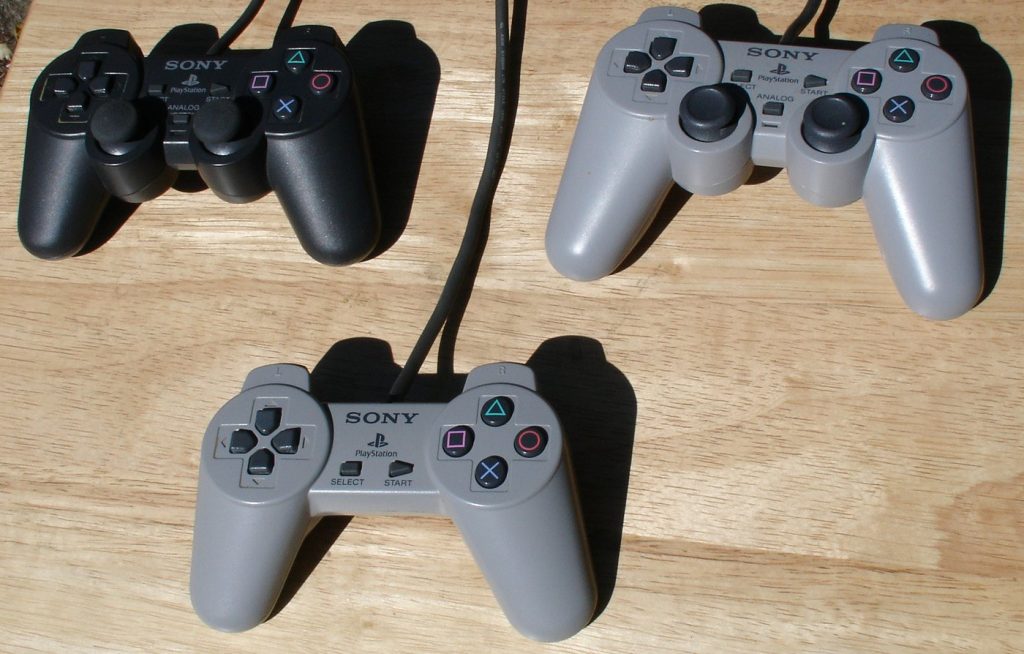
The original PlayStation controller had no analog sticks. That changed in 1997: the Dual Analog Controller was released in Japan in April 1997, and the DualShock, which added two vibration motors, followed in November 1997. The DualShock layout, with two analog sticks below the face buttons and D-pad, became the template for every later PlayStation controller.
Sony also experimented with hobbyist development. The Net Yaroze, a special black PlayStation sold with development tools for home programmers, launched in Japan in June 1996 and in other countries the following year. Its name means roughly “let’s do it together.” It was a niche product, but it showed Sony was interested in a wider community of creators.
In July 2000 Sony released the PS one, a much smaller redesign of the console. It arrived in the same year as the PlayStation 2, which could also play most original PlayStation discs. That backward compatibility let Sony move its enormous audience to the new machine without stranding their game collections.
The End of Production and the Legacy
Sony discontinued the original PlayStation on March 23, 2006, more than eleven years after its Japanese launch. Sony Interactive Entertainment’s business data lists more than 102.4 million units of hardware and more than 962 million units of software sold for the platform, as of March 31, 2012.
The PlayStation’s lasting effects go beyond its own numbers:
- Optical media became standard. After the PlayStation, discs became the default for home consoles for decades, a shift we track in our guide to console generations.
- Third parties gained leverage. Cheaper manufacturing and a less restrictive approach than Nintendo’s earlier licensing system attracted a wide range of publishers.
- Gaming grew up. The console helped establish the idea that adults were a core audience, not an afterthought.
- Sony became a platform holder. The company that once built a CD drive for Nintendo became one of the three major console manufacturers.
Sony revisited its first console in 2018 with the PlayStation Classic, a miniature plug-and-play system with 20 built-in games. It received negative reviews and sold poorly, but it showed how much nostalgia the original hardware still commands.
Collecting the Original PlayStation Today
Because Sony made so many consoles, original PlayStation hardware is common. A few points are worth knowing before buying:
- Disc drives wear out. The optical laser assembly is the most common failure point on older units. Test a console with a game before buying if possible.
- Disc condition matters. Scratches on the data side can cause read errors. Check the underside of discs carefully.
- Black-bottom discs are normal. Many PlayStation games used discs with a dark-tinted data side, which was part of Sony’s design for the format.
- Region differences. NTSC and PAL consoles and games are not freely interchangeable, and Japanese releases often differ in packaging.
Thirty years after its launch, the original PlayStation is remembered less for any single technical feature than for a set of business choices that proved correct: cheaper media, an open door to publishers, a lower price, and a pitch to an audience that the industry had largely ignored.