Is Emulation Legal? What Copyright Law and Court Cases Actually Say
Emulators versus game files and BIOS code: what Sony v. Connectix and Sony v. Bleem decided, why sharing ROMs is infringement, and why backups are murky.
Few topics in retro gaming generate as much confusion as emulation. Some people assume that anything involving an emulator is piracy. Others assume that because emulators are legal, everything you can run on one must be too. Both assumptions are wrong, and the real answer depends on separating two very different things: the emulator software itself, and the copyrighted games and system code that people run on it.
This article explains that distinction, walks through the two US court cases most often cited in emulation debates, and outlines where the law is settled and where it is not. It is written for general education about gaming history and copyright. It is not legal advice, laws differ between countries, and anyone with a specific legal question should consult a qualified lawyer in their jurisdiction.
What an Emulator Actually Is
An emulator is a piece of software (or sometimes hardware) that imitates the behavior of another system. A console emulator running on a PC pretends to be the console’s processor, graphics chip, sound hardware and memory, so that software written for the original machine can run on the new one.
Emulation is a normal part of computing and of the games business. Companies routinely use it to sell their own classic games. Nintendo’s Virtual Console service on the Wii, Wii U and 3DS sold older games running under emulation, and the Nintendo Classics libraries included with a Nintendo Switch Online subscription work the same way. Microsoft uses emulation to let Xbox One and later consoles play many Xbox 360 and original Xbox games. Emulation also plays a role in preservation, which we will return to below.
The Three Pieces: Emulator, BIOS and Game Files
Most legal discussions of emulation get clearer once you separate three components:
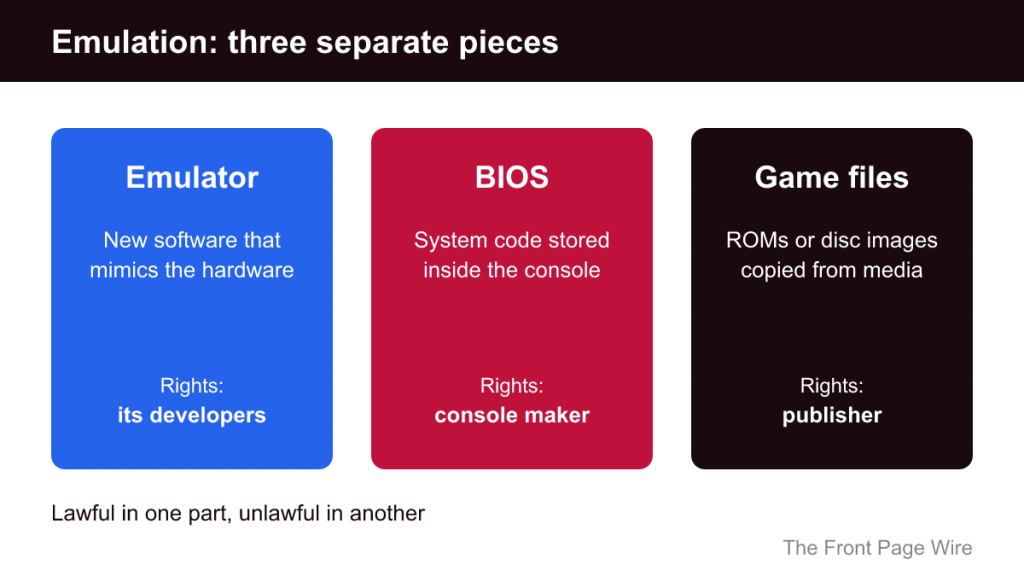
| Component | What it is | Who owns the rights |
|---|---|---|
| The emulator | New software written to mimic a system’s hardware | Its own developers |
| BIOS / firmware | System code stored inside the original console, used by some systems at startup or for core functions | The console manufacturer |
| Game files (often called ROMs or disc images) | Copies of the game data from a cartridge or disc | The game’s publisher or other rights holders |
An emulator written from scratch is a new creative work. The console’s BIOS and the games are someone else’s copyrighted works. That is why the same activity can be lawful in one part and unlawful in another.
Sony v. Connectix (2000)
The most important US case for emulator developers is Sony Computer Entertainment, Inc. v. Connectix Corp., decided by the US Court of Appeals for the Ninth Circuit on February 10, 2000.
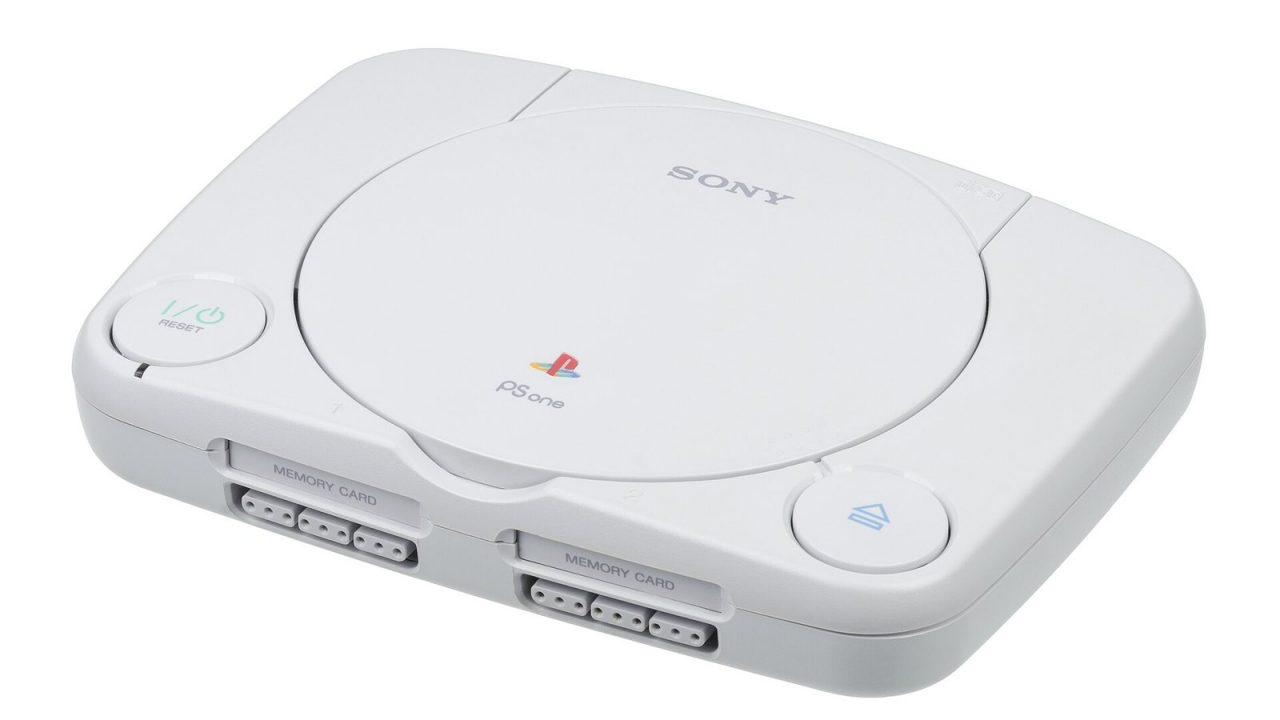
Connectix, a software company, created the Virtual Game Station, a Macintosh program released in January 1999 that let users play PlayStation discs on a Mac. To build it, Connectix reverse engineered the PlayStation. During development, its engineers made copies of Sony’s BIOS to study how the system worked, then wrote their own replacement BIOS rather than shipping Sony’s code.
Sony sued and won a preliminary injunction in the district court. The Ninth Circuit reversed it. The panel held that Connectix’s intermediate copying of the BIOS during reverse engineering was a fair use. Key points from its reasoning:
- The court relied heavily on an earlier Ninth Circuit decision, Sega Enterprises v. Accolade (1992), which had allowed reverse engineering to understand the functional elements of a system.
- It described the Virtual Game Station as “modestly transformative” because it created a new platform on which people could play their PlayStation games.
- Because the final product did not contain Sony’s copyrighted BIOS code, the amount of copying carried little weight.
- Although the emulator might reduce some console sales, the court said copyright did not give Sony a monopoly over the devices that could play its games.
Winning in court did not keep the product alive. Sony later bought the rights to the Virtual Game Station in 2001 and discontinued it.
Sony v. Bleem (2000)
bleem! was a commercial PlayStation emulator for Windows PCs, released in 1999, with a later version for the Sega Dreamcast. It was notable for using a PC’s 3D graphics hardware to render PlayStation games at higher resolutions than the original console.
Sony took legal action against bleem! on several grounds. The best-known ruling, issued by the Ninth Circuit in May 2000, concerned bleem!’s advertising. The company had used screenshots of Sony games to compare how they looked on a PlayStation and on a PC running bleem!. The appeals court found that this use of screenshots for comparative advertising was a fair use.
Like Connectix, bleem! won legally but lost commercially. The cost of defending lawsuits was heavy for a small company, and bleem! shut down in November 2001.
What These Cases Did and Did Not Decide
Taken together, these cases are often summarized as “emulators are legal in the US.” That shorthand is roughly right but needs care:
- They protect the act of building an emulator through reverse engineering, including temporary copying of system code during development, as long as the final product does not contain the copyrighted code.
- They do not authorize distributing a console’s BIOS. Shipping Sony’s or anyone else’s firmware with an emulator would be distributing copyrighted code.
- They do not authorize copying or distributing games. Neither ruling said anything that makes it lawful to share game files.
- They were decided before modern encryption. Newer systems use encryption and other technical protections, and US law treats circumventing those protections as a separate issue, discussed below.
Why Sharing and Downloading ROMs Is Infringement
A game file is a copy of a copyrighted work. In general, uploading or downloading copies of commercial games without permission from the rights holder is copyright infringement, regardless of the game’s age or whether it is still sold. Age alone does not put a game in the public domain; copyright in games from the 1980s and 1990s is still in force in the US and most other countries.
“Abandonware” is a common term for software that is no longer sold or supported, but it is not a legal category. A game being out of print, or its publisher having closed, does not remove copyright; rights usually pass to another company or remain with the original owners. Rights holders have taken legal action against websites that distribute game files, and Nintendo in particular has a long history of pursuing them.
Emulator projects themselves can also face legal trouble when they are seen as facilitating infringement. In February 2024, Nintendo of America sued Tropic Haze, the company behind the Nintendo Switch emulator Yuzu. The case settled in early March 2024 for $2.4 million, and Yuzu’s development and distribution ended. The settlement means no court ruled on the merits, so it did not change the law established by the earlier cases, but it shows that emulator developers can face serious legal risk depending on how their software works and is presented.
The DMCA and Anti-Circumvention
In the United States, Section 1201 of the Digital Millennium Copyright Act prohibits circumventing technical measures that control access to copyrighted works, and it prohibits trafficking in tools designed to do so. This matters for emulation because many consoles from the late 1990s onward use encryption or authentication. Even if copying itself might be defensible in some circumstances, breaking copy protection can be a separate violation.
The US Copyright Office reviews exemptions to Section 1201 every three years. Some exemptions have covered limited activities such as preservation work by libraries, archives and museums. These exemptions are narrow and carefully worded, and they do not create a general right for individuals to break protections on games. We will look at those rules in more detail in a later article on game preservation and the DMCA.
Personal Backups: The Murky Middle
The hardest question is whether you can legally make your own copy of a game you bought. The honest answer is that it depends on where you live and how the copy is made, and in many places the law is unclear or untested for games specifically.
- Some countries have private-copying or backup exceptions in their copyright laws, but these often come with conditions, apply only to certain types of works, or do not allow circumventing copy protection.
- In the US, some argue that a provision allowing archival copies of computer programs covers personal backups, but how that interacts with anti-circumvention rules is uncertain.
- Downloading a copy from the internet is generally not the same as making your own backup, even if you own the original. Many legal commentators treat it as infringement because the download comes from an unauthorized source.
Because of this uncertainty, we cannot give a simple yes or no for any country, and you should not rely on online forums for a definitive answer. If the question matters to you, look at official guidance from your country’s copyright office or ask a lawyer.
Emulation and Preservation
None of this means emulation is a fringe or shady activity. Preservationists, historians and museums see accurate emulation as one of the few long-term ways to keep games playable as original hardware fails and media decays. Emulators can document how hardware behaved, allow researchers to study games, and keep software from defunct companies accessible in legal settings such as archives. Industry figures have also spoken in favor of it; in 2021 Xbox head Phil Spencer said he hoped for legal emulation across the industry, describing it as a “North Star.”
For players, the clearest legal options are the official ones: re-releases, compilations, subscription libraries and plug-and-play consoles that license games properly. If you collect originals, as our guide to starting a retro game collection describes, playing them on original hardware is of course also entirely lawful.
Quick Summary
- Emulators: In the US, building an emulator through clean reverse engineering has been upheld by courts, most notably in Sony v. Connectix (2000).
- BIOS files: Copyrighted by the console maker; distributing them is not covered by those rulings.
- Game files: Copyrighted; sharing or downloading commercial games without permission is infringement, regardless of age.
- Copy protection: Circumventing it raises separate legal issues under laws such as the DMCA.
- Personal backups: Varies by jurisdiction and is often unclear. This article is not legal advice.
For the broader story of how these consoles fit into gaming history, see our overview of console generations.