The Golden Age of Arcade Games: How Coin-Op Machines Took Over the World
How Space Invaders, Asteroids, Pac-Man, Donkey Kong and friends built the late-1970s arcade boom, why it faded, and how fighting games revived arcades.
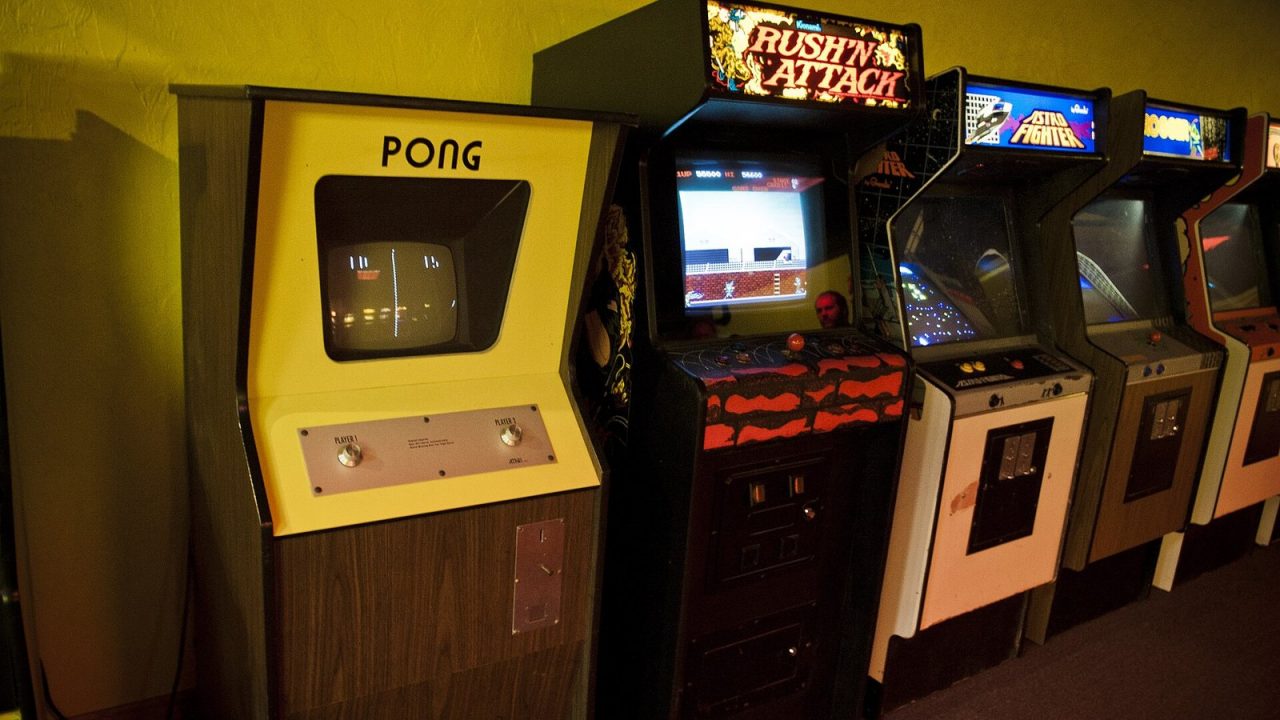
For a few years at the turn of the 1980s, the video arcade was one of the most important places in popular culture. Teenagers fed quarters into upright cabinets in malls, pizza parlors, bowling alleys and convenience stores. Songs, cartoons and lunchboxes were built around characters who had begun life as a handful of pixels. Players chased high scores the way earlier generations chased batting averages.
Historians call this period the golden age of arcade video games. This article looks at how it began, the landmark machines that defined it, the culture that grew up around it, and why the boom faded, before a new genre brought crowds back in the 1990s.
When Was the Golden Age?
There is no official start or end date, and writers draw the lines slightly differently. Some date the beginning to 1978, when Taito’s Space Invaders appeared in Japan. Others, such as historian Steven L. Kent, prefer 1979, when Space Invaders became a hit in the United States and Atari’s vector-graphics Asteroids arrived. The trade magazine RePlay described the “video boom” as running from 1979 to 1982, and most accounts agree that a steady decline had set in by 1983.
Arcade video games existed before this, of course. Atari’s Pong (1972) had proven that people would pay to play a video game in a public place. But the late-1970s machines were different in scale. They had characters, enemies that fought back, escalating difficulty, and scores worth bragging about, and they arrived in such numbers that arcades themselves multiplied.
The Machines That Defined the Era
Dozens of games were popular, but a handful of releases shaped what arcade games became. Release years below refer to the original arcade versions.
| Game | Year | Maker | Why it mattered |
|---|---|---|---|
| Space Invaders | 1978 | Taito (licensed to Midway in the US) | Established the shoot ’em up and the idea of escalating waves |
| Asteroids | 1979 | Atari | Vector graphics, free movement, initials on the high-score table |
| Galaxian | 1979 | Namco | Multicolored animated sprites, diving enemies |
| Battlezone | 1980 | Atari | First-person pseudo-3D tank combat |
| Pac-Man | 1980 | Namco | A character-led maze game with mass appeal |
| Defender | 1981 | Williams | Fast, complex side-scrolling shooter |
| Donkey Kong | 1981 | Nintendo | Template for the platform game; introduced Jumpman, later Mario |
| Galaga | 1981 | Namco | Refined Galaxian, added a bonus stage |
| Centipede | 1981 | Atari | Trackball shooter co-created by Dona Bailey |
| Tempest | 1981 | Atari | One of the first color vector games |
Space Invaders: the spark
Space Invaders gave players a laser cannon, a few protective bunkers and rows of descending aliens that sped up as they were destroyed. It popularized the idea of multiple lives and progressively harder waves, and it showed operators how much money a single video game could make. Wikipedia’s history of the era credits it with selling more than 360,000 cabinets worldwide. Its story deserves more space than we can give here, and it gets its own article later in this series.
Asteroids and vector graphics
Atari’s Asteroids used a vector display that drew bright, sharp lines instead of the raster pixels of most games. Players could rotate, thrust and wrap around the screen, which felt very different from the fixed cannon of Space Invaders. It became Atari’s most successful coin-op game, and it was among the first games to let players enter their initials next to a high score, a small feature with huge cultural consequences.
Pac-Man: games for everyone
Namco’s Pac-Man deliberately moved away from shooting. Its maze, dots and four ghosts created a game that people who had no interest in space combat wanted to try, and it became a merchandising phenomenon. It is often described as the highest-grossing arcade game of all time, with around 400,000 cabinets sold according to figures cited by Wikipedia.
Donkey Kong, Defender and the 1981 wave
1981 may have been the creative peak of the era. Nintendo’s Donkey Kong told a simple story across several screens and set the template for the platform genre, while introducing the character who would become Mario. Williams’ Defender was fast and demanding, with a scrolling world and many controls. Namco’s Galaga built on Galaxian and became one of the most enduring shooters in arcades. Atari’s Centipede and Tempest showed how varied control schemes, from trackballs to spinners, could become.
How Big Did It Get?
Numbers from this era need care, because many were estimates made by trade magazines and analysts rather than audited figures. Still, the commonly cited estimates give a sense of scale:
- US arcade revenue from coins is reported to have roughly tripled to about $2.8 billion in 1980.
- Estimates for 1981 range from more than $5 billion to more than $7 billion depending on the source.
- One frequently quoted estimate for 1982 puts arcade revenue at around $8 billion, which would have exceeded the combined revenues of the pop music and Hollywood film industries that year.
The number of places to play grew too. Dedicated arcades in North America roughly doubled between 1980 and 1982, and machines spread far beyond them into restaurants, supermarkets, gas stations and bars.
Arcade Culture: Scores, Initials and Parlors
What made the golden age feel like a cultural moment rather than a product cycle was the social life that grew around the machines.
- The high-score table. Once players could leave their initials on a machine, a good score became public. Three letters on the attract screen of the local Asteroids or Galaga cabinet were a reputation, and regulars knew whose initials were whose.
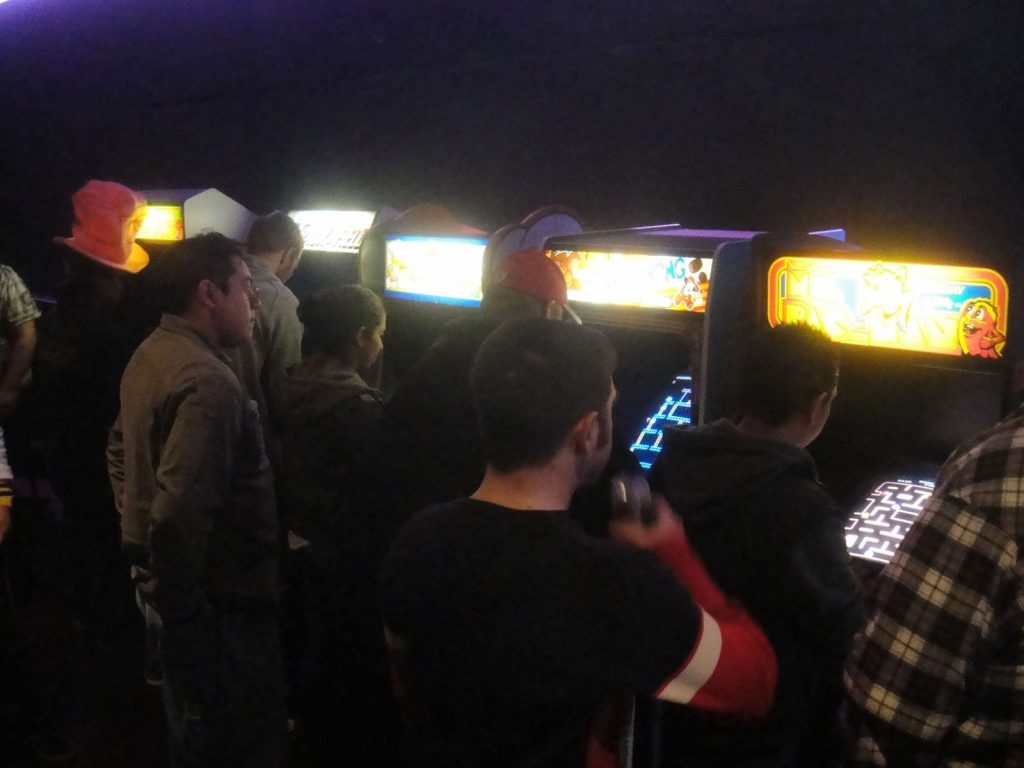
- Watching as entertainment. A crowd often gathered behind a skilled player. Learning by watching, then trying a pattern yourself, was how many people got better before strategy guides existed.
- Patterns and strategy. Because many early games were deterministic, players discovered repeatable routes through levels. Pac-Man patterns, for instance, circulated by word of mouth and in books.
- The arcade as a hangout. Arcades were social spaces with their own etiquette, such as putting a coin on the cabinet’s bezel to claim the next game.
- Pop-culture crossover. Arcade characters turned up on cereal boxes, in Saturday-morning cartoons and in hit novelty songs, and films such as Tron (1982) put arcade-style imagery on the big screen.
Arcades were also controversial. Some parents, politicians and local councils worried that they encouraged truancy or gambling-like behavior, and some towns tried to restrict them. That moral panic is one of the factors historians cite in the arcade decline.
Why the Boom Faded
From around 1983 the arcade business began to shrink. The decline overlapped with the home console collapse described in our article on the video game crash of 1983, but historians generally treat the two as separate stories with different causes:
- Too many clones. Successful games were copied endlessly, and operators found their floors filled with similar machines that earned less and less.
- Better home games. As home consoles and computers improved, the gap between the arcade and the living room narrowed. A family that owned a console had less reason to spend quarters.
- Rising costs. New cabinets were expensive, and operators had to keep buying them to keep customers interested.
- Social pressure. Concerns about arcades’ effect on children made some locations less welcoming.
Arcades did not vanish. Games such as Gauntlet and Out Run kept many arcades busy in the mid-1980s, and the industry made changes that helped operators. One was the JAMMA wiring standard introduced in Japan in 1985, which let operators swap game boards inside existing cabinets instead of buying whole new machines. But the explosive growth of 1979 to 1982 did not return.
The Fighting Game Revival
The arcade’s second wind came from a genre built for two people standing side by side. Capcom’s Street Fighter II, released in March 1991, introduced a roster of distinct characters with special moves, and it changed the arcade’s social dynamic from chasing your own high score to beating the person next to you.
Its impact was large. Capcom sold tens of thousands of cabinets, and contemporary trade coverage credited the game with bringing life back to struggling arcades and even to convenience-store locations that had stopped carrying games. Revisions such as Champion Edition sold in even greater numbers in Japan. Other companies followed with their own fighters, notably Midway’s Mortal Kombat in 1992, and the fighting game boom carried arcades well into the 1990s.
The 1990s revival looked different from the golden age. Arcades leaned on experiences that were hard to replicate at home: head-to-head fighting, big sit-down driving cabinets, light-gun games and, later, rhythm games. As home consoles caught up technically, the advantage shrank again, and in North America arcades became rarer from the late 1990s onward, while Japan’s game centers held on much longer.
Common Misconceptions About the Era
- “Arcades died in 1983.” Growth stopped and many locations closed, but arcades kept operating through the mid-1980s and boomed again with fighting games in the 1990s.
- “Every golden-age game was American.” Several of the most influential titles, including Space Invaders, Pac-Man, Galaxian, Galaga and Donkey Kong, came from Japanese companies. Many reached North America through licensing deals, such as Midway distributing Space Invaders and Pac-Man.
- “Revenue numbers are exact.” Most figures from this period are trade estimates. They are useful for showing the scale of the boom, not as precise accounting.
- “The arcade crash and the console crash were the same thing.” They overlapped in time and fed off each other, but the arcade decline had its own causes, from clone saturation to local opposition.
The Legacy of the Golden Age
The golden age gave gaming much of its basic vocabulary. Lives, levels, escalating difficulty, high-score tables and recognizable characters all come from this period. So do many of the genres we still recognize: shooters, maze games and platformers. Companies that became giants of the home console era, including Nintendo and Namco, built their reputations on arcade hits, and the 1980s arcade look still drives retro aesthetics today.
For the history of how these games reached living rooms, see our overview of console generations, which traces the home systems that eventually brought arcade-quality games home.