The Legend of Zelda (1986): Why the Original Still Matters
From the Famicom Disk System to the gold NES cartridge, how the 1986 Legend of Zelda pioneered open exploration and battery saves.
The first screen of The Legend of Zelda gives you almost nothing. A small figure stands in a clearing. Paths lead off in several directions, and there is a dark opening in a rock wall. No arrow tells you where to go, and no tutorial explains what the buttons do. If you walk into the cave, an old man offers you a sword with the line “It’s dangerous to go alone! Take this.” If you do not, the game lets you wander off unarmed.
That trust in the player is what makes the 1986 original important. This article looks only at that first game: how it was born on Nintendo’s disk add-on in Japan, why its American cartridge carried a battery and came in gold plastic, how its open structure and Second Quest worked, and what later action-adventure games took from it.
Born on the Famicom Disk System
The Legend of Zelda was released in Japan on February 21, 1986, the same day Nintendo launched the Family Computer Disk System. The Disk System was an add-on for the Famicom that used proprietary floppy-style “Disk Cards” based on Mitsumi’s Quick Disk format. Each double-sided disk held 112 KB, more than most cartridges of the time, and the format could store save data that players could overwrite.
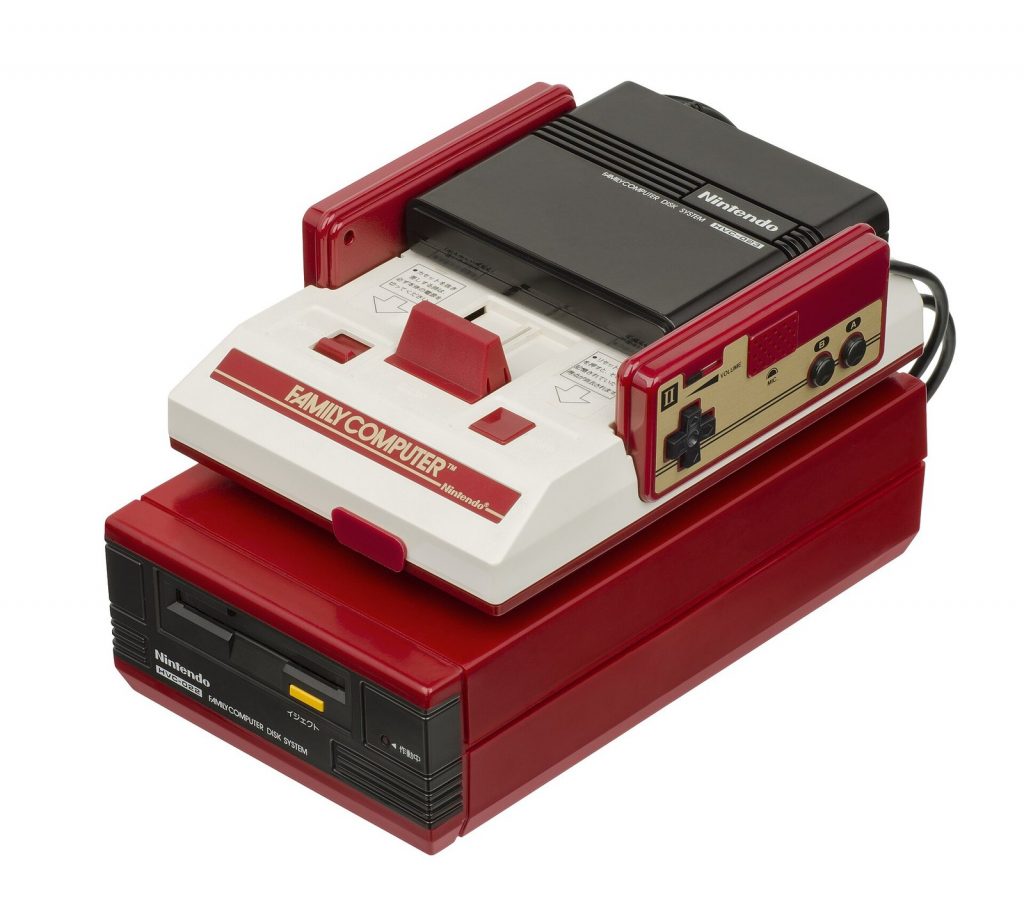
Nintendo had practical reasons for the format. Chip-based cartridges were expensive and supply was sometimes constrained by component shortages, while disks were cheap to manufacture. Players could even take a disk to a Disk Writer kiosk in a store and have a new game written onto it for ¥500, a fraction of the price of a new cartridge. The add-on itself launched at ¥15,000.
Zelda was a natural showcase. It was larger than a typical action game, and the ability to save progress was essential for a quest meant to be played over many sessions. The add-on went on to sell about 4.4 million units, but the format had drawbacks: disks were fragile, loading was slow, and copying was widespread. By the end of the decade, cartridges with battery-backed memory had become a practical alternative.
The Battery Save and the Gold Cartridge
The Disk System never launched outside Japan, so Nintendo had to bring Zelda to the NES as a cartridge. The North American version arrived on August 22, 1987, and the European release followed on November 15, 1987.
To preserve the ability to save, the Western cartridge included an internal battery that kept a small amount of memory powered when the console was off. According to The Strong National Museum of Play, it was the first console game in the North American market to include an internal battery for saving data. Before this, home console players typically had to finish a game in one sitting or rely on password systems. A battery-backed save made a long adventure realistic for a home audience and became standard for large games over the next decade.
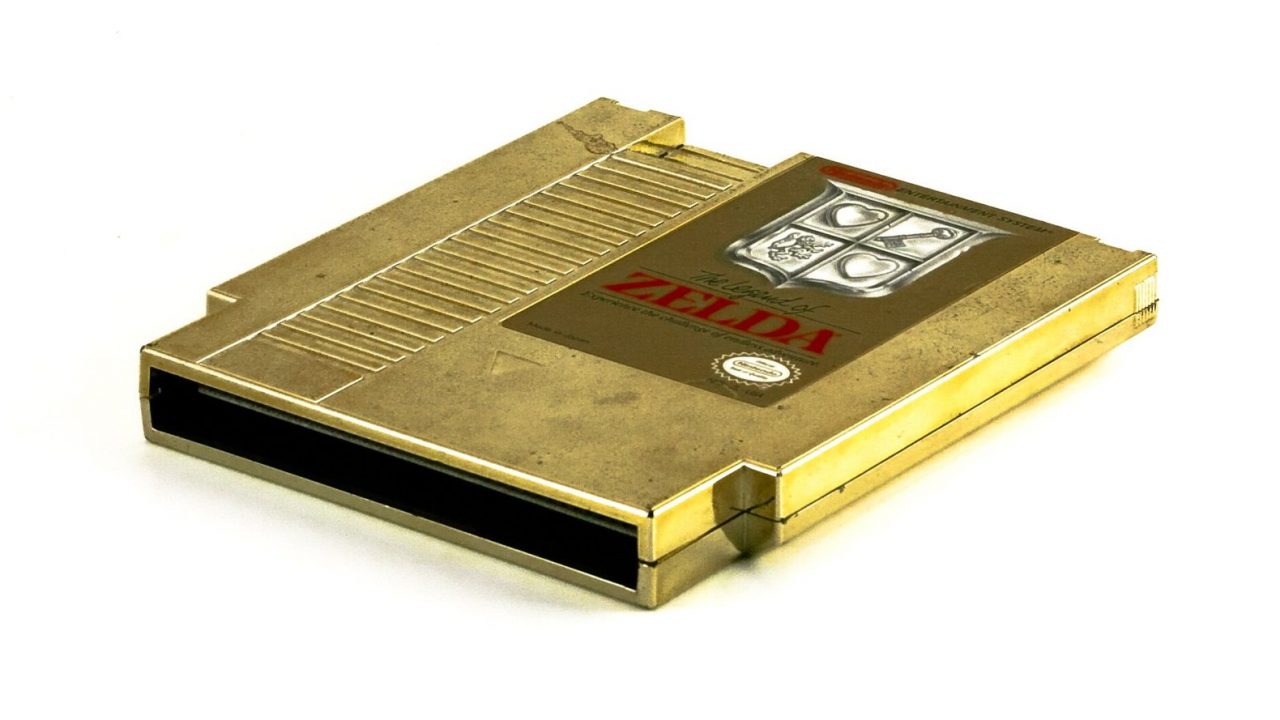
The cartridge was also visually different. Instead of the usual grey plastic, The Legend of Zelda shipped in a gold-colored shell, and the box included a small cut-out window so shoppers could see it. It was a simple but effective piece of marketing, signaling that this was something special on a crowded shelf. Gold has since become a recurring color for special Zelda editions.
The game sold well. Reference sources report that it became the first NES game to sell over one million cartridges in the United States, a milestone reached in 1987, and lifetime worldwide sales of about 6.51 million copies. For the broader story of how the NES built its audience in that period, see our history of the Nintendo Entertainment System.
Designing for Discovery
The game was directed and designed by Shigeru Miyamoto and Takashi Tezuka, developed by Nintendo’s R&D4 team, with music by Koji Kondo. The same team was working on Super Mario Bros. at around the same time, and the two games can be seen as opposite answers to a design question. Mario moves left to right along a carefully paced line; Zelda drops the player into a world and lets them choose a direction. (Our article on Super Mario Bros. covers that game’s design.)
Miyamoto has often linked the game’s sense of exploration to his childhood in the countryside near Kyoto, where he explored fields, woods and caves. The idea was to recreate the feeling of stumbling upon something unexpected, and the game’s structure supports it in several ways:
- An open overworld. Hyrule is divided into screens that connect in every direction. Most areas are accessible from the start, though dangerous enemies discourage the player from going too far too soon.
- Non-linear dungeons. The game contains eight dungeons that hold fragments of the Triforce of Wisdom, plus a final ninth dungeon where Ganon waits. Players can tackle several dungeons out of the intended order.
- Hidden secrets. Bombable walls, burnable bushes and movable blocks hide shops, caves, heart containers and dungeon entrances. The game rarely signposts them.
- Item-based progression. Tools such as the raft, ladder, bow and candle open up new areas or reveal secrets, so progress depends on what you have found rather than a fixed sequence.
The game’s freedom is real: players have long noted that it is possible to reach the final confrontation without picking up the sword the old man offers at the start. Few games of the period would have allowed that.
Kondo’s Music and a Famous Late Change
Koji Kondo had just composed the Super Mario Bros. soundtrack when he worked on Zelda. One well-documented story is that he originally planned to use Maurice Ravel’s Boléro for the title screen, then learned shortly before release that the piece was still under copyright in Japan. He wrote a replacement quickly, and the overworld theme he produced became one of the most recognizable melodies in game music, reused and rearranged throughout the series.
The title track’s rhythm and the short jingle that plays when you uncover a secret are good examples of how much information early game music carried. With limited sound channels, Kondo created motifs that worked as feedback: the “secret found” sound tells the player they have done something right, a cue later games in many genres echoed.
The Second Quest
Finishing the game did not end it. After completing the First Quest, players unlocked the Second Quest, a remixed version of the adventure with relocated dungeons, rearranged items and secrets, and tougher enemies. Dungeon shapes and locations change, so players who memorized the first map had to explore again.
There was also a shortcut that spread through playgrounds and magazines: entering “ZELDA” as the name on a new save file started the Second Quest immediately. Nintendo Power covered the Second Quest in its early issues, and the game’s difficulty had already been a reason for Nintendo to set up its fan newsletter. The Strong museum notes that player conversations about the game’s challenge helped lead to the Nintendo Fun Club newsletter, which later became Nintendo Power.
Today, a “harder remixed second run” is a familiar idea, often called New Game Plus. In 1986, building a substantial second layout into the same cartridge was a generous extra and a clever use of limited storage, since it reused the same assets in a new arrangement.
Influence on Action-Adventure Design
When The Strong inducted The Legend of Zelda into its World Video Game Hall of Fame in 2016, it credited the game with popularizing non-linear, open-world exploration and paving the way for many later role-playing and action-adventure games. The museum specifically mentions its influence on Square’s Final Fantasy and Nintendo’s own Metroid. Game Informer twice ranked it first in its lists of the greatest games of all time, in 2001 and 2009.
Several ideas from the 1986 game are now so common that they are easy to overlook:
- A top-down action-adventure template. Real-time combat, an overworld connecting dungeons, and items that unlock new areas became a widely copied structure.
- Saving as a design assumption. Once players could save, designers could build longer, denser worlds.
- Exploration as reward. Hidden rooms and optional heart containers made curiosity itself a mechanic.
- Dungeons as puzzles. Keys, locked doors, and a dungeon map and compass turned each dungeon into a navigational challenge.
- Player-driven discovery. The game assumed players would share tips with friends, and that culture became part of how it was played.
Playing and Collecting the Original Today
The original has been re-released many times. In Japan, a cartridge version for the standard Famicom followed on February 19, 1994. Outside Japan, it appeared on the Game Boy Advance in 2004 as part of the Classic NES Series, on the Wii Virtual Console in 2006, and in Nintendo’s online classic-games library on the Switch starting September 18, 2018. These official versions are the simplest way to experience it on a modern TV.
For collectors, a few points are worth keeping in mind:
- Completeness. The windowed box, manual and any original inserts add considerably to a copy’s appeal, so check what is actually included.
- The save battery. After decades, the internal coin-cell battery may have run out, which means the game will not keep saves. The game itself still plays.
- Reproductions. Because the gold cartridge is so recognizable, it is a common target for reproductions. Check label quality, shell color and the board inside, as covered in our guide to spotting fake and reproduction retro games.
- Disk System copies. Japanese Disk Card versions exist and are interesting historical items, but disks are fragile and require working Disk System hardware.
Why It Still Matters
Plenty of influential games are more admired than played. The Legend of Zelda is different because its central idea still works. Its graphics are simple and its combat stiff by modern standards, but the experience of choosing a direction, finding a hidden staircase and realizing you have stumbled onto a dungeon you were not meant to find yet remains compelling. That is the legacy Miyamoto and Tezuka built: not a story to follow, but a world to figure out, and a design that treated players as capable explorers from the very first screen.