The Atari 2600: History of the Console That Brought Arcades Home
From the 1977 Atari VCS launch and Warner's money to racing the beam and Activision's revolt, the history of the Atari 2600.
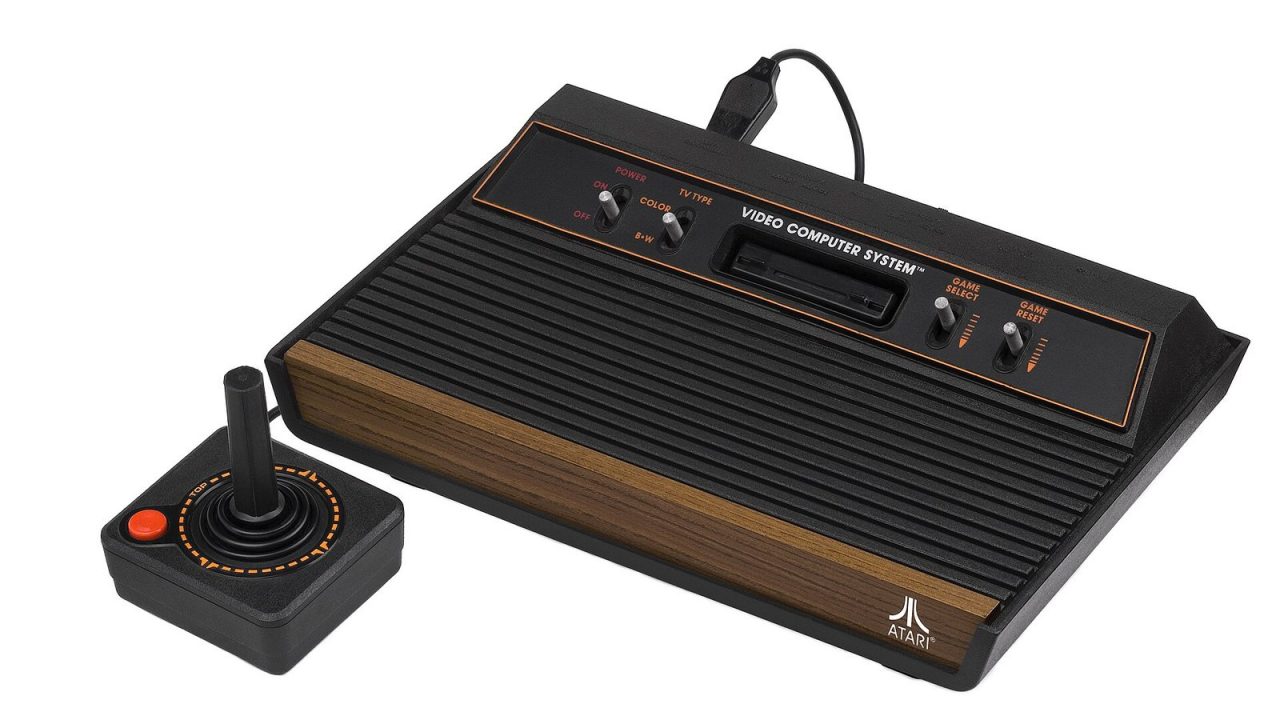
For millions of families in the late 1970s and early 1980s, “Atari” simply meant video games. The machine behind that reputation was a woodgrain-trimmed box with a joystick and a slot for cartridges, launched in 1977 as the Atari Video Computer System. It was not the first console with interchangeable cartridges, and it was astonishingly limited even by the standards of its day. Yet it sold about 30 million units, shaped how people thought about home gaming, and indirectly created the business model of the independent game publisher.
This article covers the console’s origins under Warner Communications, its programmable cartridge design, the technical constraint known as “racing the beam,” the founding of Activision, the many hardware revisions, and why it stayed on sale for roughly 15 years.
From Pong to “Stella”: Why Atari Needed Warner
Atari had built its early success on arcade machines and dedicated home Pong units, as described in our article on Pong and the birth of Atari. Dedicated consoles had a fundamental problem: each could play only the games built into it. Once the novelty wore off, the hardware was obsolete.
The answer was a programmable console that loaded games from cartridges. Atari’s project was codenamed “Stella.” Its original design was developed by Steve Mayer and Ron Milner at Cyan Engineering, an Atari-affiliated engineering group; Jay Miner created the custom graphics chip, and Joe Decuir debugged the early prototype.
Bringing such a product to market required far more money than Atari had. The company was still recovering from financial problems earlier in the decade. In October 1976, Warner Communications agreed to buy Atari for $28 million, and Warner’s investment, reported at around $120 million, made it possible to fast-track the console. Nolan Bushnell stayed on for a time but clashed with the new owners over the company’s direction and left in 1979.
Atari was not first with the idea. Fairchild’s Channel F, released in 1976, already used swappable cartridges. But Atari’s brand recognition, arcade connections and Warner’s marketing muscle gave the VCS a far bigger platform.
VCS or 2600? Getting the Name Right
The console launched in 1977 as the Atari Video Computer System, or VCS. Its manufacturer part number was CX2600. In November 1982, when Atari released its more powerful Atari 5200, it renamed the original machine the Atari 2600, after that part number. So both names are correct, but “VCS” is historically accurate for the early years, and “2600” for later ones.
Sears sold its own branded versions through its Tele-Games line, under the name Video Arcade, which is why some collectors find Sears-branded consoles and cartridges with different labels.
The 1977 Launch and a Slow Start
The exact on-shelf date is uncertain, but the VCS reached stores around September 1977. It shipped with two joysticks and Combat as the pack-in game. Nine cartridges were available at launch. Reported launch pricing varies by source between about $190 and $199.
Sales were modest at first. Atari sold an estimated 350,000 to 400,000 units in 1977, hampered by shipping delays and consumers’ unfamiliarity with the idea of buying separate cartridges. In 1978 it sold about 550,000 of the 800,000 units it manufactured and needed further support from Warner.
The turning point was a licensed arcade hit. Atari obtained the home rights to Taito’s Space Invaders, and the VCS conversion released in 1980 became the system’s killer application, selling over a million cartridges that year. (For the original arcade game’s story, see our history of Space Invaders.) For the first time, people bought the console specifically to play a particular game at home, establishing the strategy of licensing arcade hits that would define home consoles for years.
Inside the Box: 128 Bytes and Racing the Beam
The VCS was designed to be cheap. Its main components were:
| Component | Details |
|---|---|
| CPU | MOS Technology 6507, a cost-reduced version of the 6502, at about 1.19 MHz |
| Graphics and sound | Television Interface Adaptor (TIA), a custom chip designed by Jay Miner |
| RAM | 128 bytes |
| Cartridges | 2K at launch, 4K standard; bank switching later allowed 8K, 16K and more |
One hundred and twenty-eight bytes is not a typo. That was the console’s entire working memory, smaller than this paragraph. Crucially, there was no frame buffer: no memory that held a complete image of the screen. Instead, the TIA drew the picture one horizontal line at a time as the television’s electron beam swept across the screen.
This forced programmers into a technique known as racing the beam. A game’s code had to update the graphics registers in step with the TV’s scan, changing colors, sprite positions and background patterns line by line, just before the beam reached them. Game logic, such as reading the joystick or moving enemies, could only run while the beam was off the visible screen, in the vertical blanking period.
The TIA itself offered very few graphical objects:
- A low-resolution playfield covering half the screen, repeated or mirrored on the other half
- Two player sprites, each eight pixels wide
- Two missiles and one ball, simple single-bit objects that could be stretched
These features were designed around games like Combat and Pong-style titles: two players, a couple of projectiles, a ball and a background. Everything more ambitious, from the multi-colored scrolling of later games to more than two characters on screen, came from programmers inventing tricks to reuse and reposition those objects mid-frame. That is why later 2600 games look dramatically better than launch titles running on the same hardware.
The constraint also explains the 2600’s famous flicker. When a game needed more moving objects than the hardware supported, programmers often drew them on alternate frames, making them shimmer. The much-criticized 1982 port of Pac-Man, discussed in our history of Pac-Man, is a well-known example. Despite its reception, it became the best-selling 2600 game.
Activision and the Birth of Third-Party Publishing
At Atari, game programmers were not credited on packaging and did not receive royalties, even when their games sold in huge numbers. In 1979, a group of Atari’s top programmers asked for treatment similar to that of recording artists: royalties and their names on the boxes. According to reference accounts, CEO Ray Kassar dismissed them, reportedly calling them “towel designers” and saying anyone could make a cartridge.
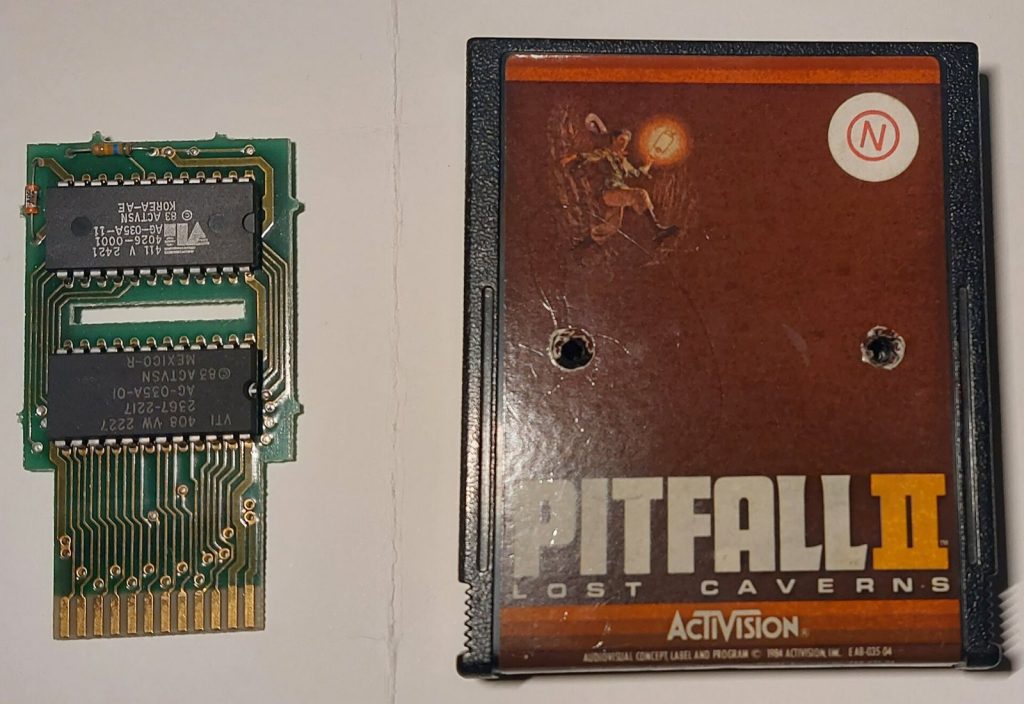
David Crane, Larry Kaplan, Alan Miller and Bob Whitehead left and, with music industry executive Jim Levy as CEO, founded Activision on October 1, 1979. It was the first independent developer and publisher of console games. Its first releases for the VCS, such as Dragster, Fishing Derby, Checkers and Boxing, arrived in 1980. Activision’s manuals dedicated space to crediting the designer, and its colorful boxes showed real screenshots.
Atari sued, alleging theft of trade secrets and breach of non-disclosure agreements. The case was settled by 1982, with Activision agreeing to pay royalties to Atari. The settlement effectively legitimized the idea that outside companies could make games for a console they did not own. Activision’s hits followed: Kaboom! (1981) became its first million-seller, and David Crane’s Pitfall! (1982) sold more than four million copies.
The precedent had a downside. Without a way to control who published games, the market was soon flooded with cartridges from companies of widely varying quality, a factor in the market collapse covered in our article on the video game crash of 1983. Later console makers, starting with Nintendo, built licensing controls specifically to avoid repeating that situation.
The Many Models of the 2600
The console’s long life produced several hardware revisions. Collectors usually identify them by nicknames:
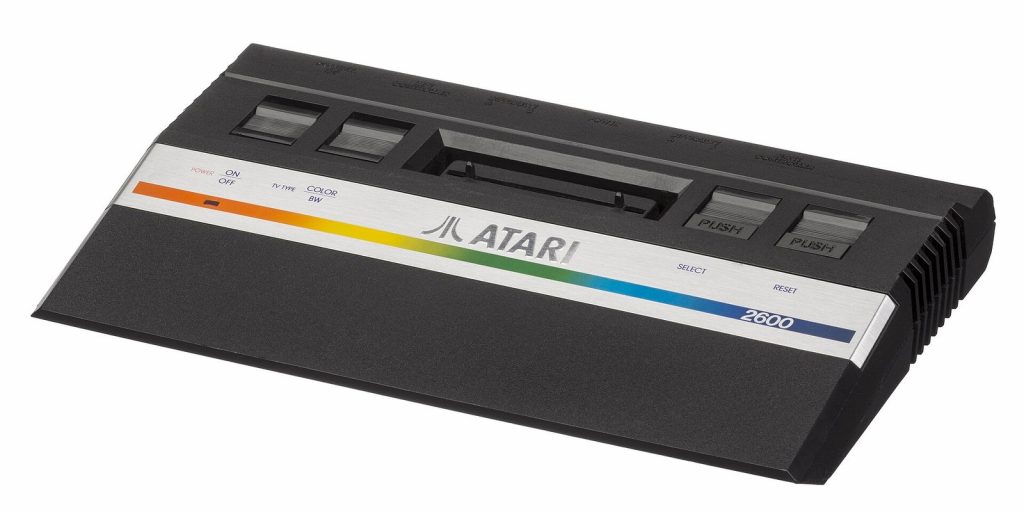
- “Heavy Sixer” (1977): the earliest models, with six front switches and a heavier case.
- “Light Sixer”: a lighter version of the six-switch design.
- Four-switch model (1980): moved the difficulty switches to the back.
- “2600 Jr.” (1986): a small, cost-reduced redesign sold during the console’s late revival.
Sears-branded Video Arcade models add further variety. For collectors, early Heavy Sixers carry the most historical cachet, while the Jr. is a practical, compact machine.
Classic Games and Design Milestones
The 2600 library contains several important firsts. Adventure (1980) is widely regarded as the first action-adventure game, and it contained one of the first known hidden “Easter eggs” in a home game: programmer Warren Robinett secretly placed his own name in the game because Atari did not list programmer credits. Arcade conversions such as Space Invaders, Asteroids and Missile Command showed how far programmers could push the hardware.
Third-party releases expanded the range further. Pitfall! offered a large side-scrolling jungle to explore, and many developers learned to stretch limited cartridge space with bank switching, allowing larger games later in the system’s life.
Crash, Revival and a Long Goodbye
The 1983 crash hit Atari hard. In July 1984, Warner sold Atari’s consumer electronics and home computer divisions to former Commodore chief Jack Tramiel, who renamed the business Atari Corporation. Yet the 2600 did not disappear. Its low cost and huge library kept it on sale through the late 1980s, with the redesigned 2600 Jr. aimed at budget buyers. New cartridges continued to appear; one late release, Fatal Run (1990), used 32K of memory, far beyond the 2K of launch games. Production finally ended in 1992, around 15 years after launch, with total sales of about 30 million units.
The console has enjoyed a modern afterlife. In 2023, Atari released the Atari 2600+, a slightly smaller replica that plays most original 2600 and 7800 cartridges over HDMI. A thriving homebrew community also continues to write new games for the original hardware, treating its tight constraints as a creative challenge.
Why the 2600 Still Matters
The Atari 2600’s importance is not in its specifications. It proved that a programmable home console could become a mass-market product, that licensed arcade games could sell hardware, and that independent publishers could build businesses on someone else’s platform. Its limits also produced a generation of programmers who learned to do extraordinary things with almost nothing, an approach to design that still inspires developers working with retro hardware today.