The Nintendo 64: Cartridges, the Analog Stick and the Leap to 3D
How the Nintendo 64 pioneered the analog stick and rumble, why its cartridges cost it third-party support, and what became of the Japan-only 64DD.
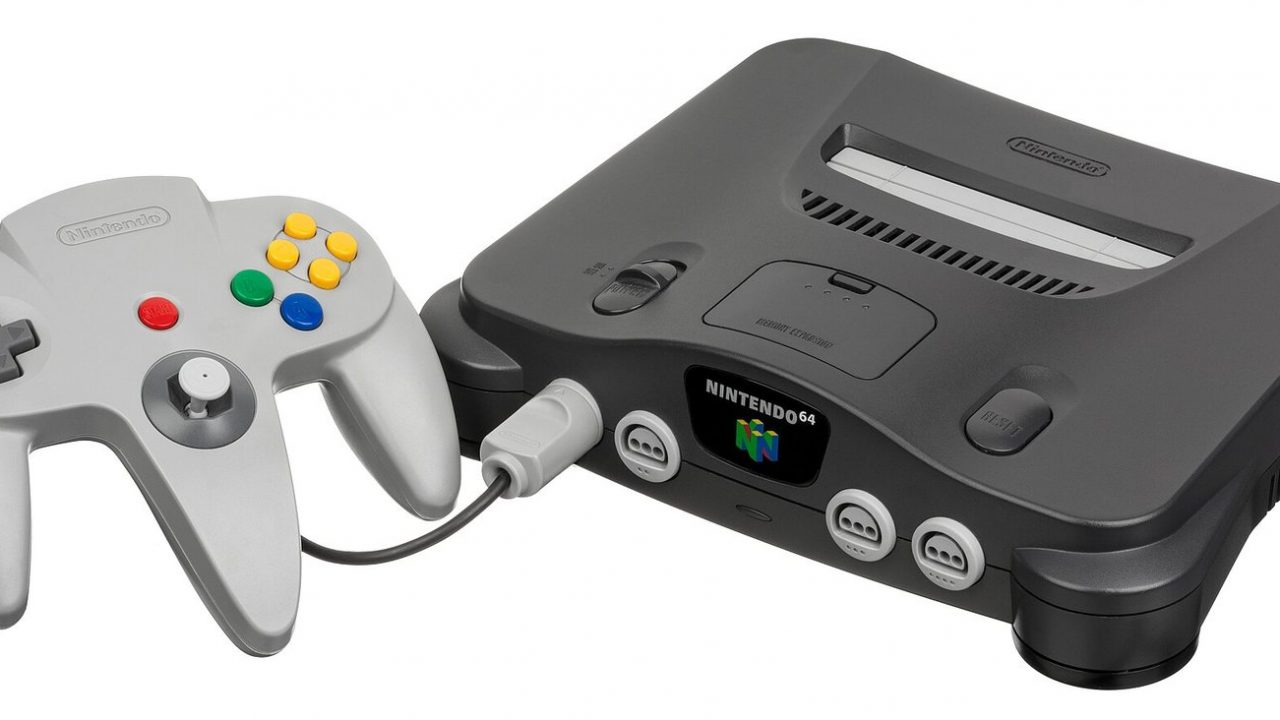
The Nintendo 64 is a console of contrasts. It introduced an analog thumbstick as standard, popularized controller vibration, and made four-player split-screen gaming a living-room staple. It also stuck with cartridges at the exact moment the rest of the industry moved to CDs, a decision that cost Nintendo some of its most important partners. The result was a console that finished well behind Sony’s PlayStation in overall sales, yet produced games that defined how 3D games would be controlled for decades.
This article covers the console’s development with Silicon Graphics, its 1996 launch, the cartridge decision and its consequences, the controller and Rumble Pak, local multiplayer culture, and the Japan-only 64DD.
Project Reality: Nintendo and Silicon Graphics
In August 1993, Nintendo announced a partnership with Silicon Graphics (SGI), the American company whose workstations were famous for 3D graphics in film and engineering. The project, called “Project Reality,” aimed to bring workstation-class 3D graphics to a home console at an affordable price.
The final hardware paired an NEC VR4300 processor running at 93.75 MHz with SGI’s Reality Coprocessor (RCP), which handled graphics and audio at 62.5 MHz. The console had 4 MB of RDRAM, which could be doubled to 8 MB with the Expansion Pak accessory released later for certain games. Its 3D capabilities included features such as texture filtering and anti-aliasing that smoothed the blocky, shimmering look common in early 3D games on other systems, though at the cost of a sometimes blurry image.
The console arrived later than its main rivals. Sony’s PlayStation and Sega’s Saturn had launched in Japan in late 1994, and Nintendo’s previous console, covered in our history of the Super Nintendo, had carried the company through the delay.
The 1996 Launch
The Nintendo 64 launched in Japan on June 23, 1996. In North America, it was advertised for September 29, 1996, though some stores began selling it a few days earlier. Europe and Australia followed on March 1, 1997.
The US launch price was $199.99. Nintendo had originally intended a higher price but cut it to compete with Sony and Sega. The North American launch lineup was tiny, just two games: Super Mario 64 and Pilotwings 64. But Super Mario 64 was enough to make an impression. It became the console’s best-selling game, at about 11 million units, and established how a 3D platformer could control and how a camera could follow a character through a 3D world. Time magazine named the Nintendo 64 its Machine of the Year for 1996.
Why Nintendo Stayed With Cartridges
By 1996, CD-ROM had become the obvious choice for game media. Sony’s PlayStation proved the benefits: discs were cheap to manufacture and held around 650 MB. Nintendo chose to stay with cartridges anyway, and gave several reasons:
- Load times. Cartridges are read almost instantly, avoiding the loading screens common in CD-based games.
- Piracy resistance. Cartridges were much harder to copy than CDs.
The downsides were significant. Cartridges cost far more to produce than CDs, which pushed up game prices and left publishers carrying more financial risk. Manufacturing lead times were longer, making it harder to respond to demand. Above all, capacity was limited: N64 cartridges topped out at 64 MB, a fraction of a CD’s capacity.
That capacity limit had a famous consequence. Square, which had developed many of the most successful role-playing games for Nintendo’s earlier consoles, moved Final Fantasy VII to the PlayStation, and Enix moved Dragon Warrior VII there as well, in part because of storage constraints. Games built around extensive full-motion video, large amounts of recorded audio or many pre-rendered backgrounds were simply impractical on cartridge. The broader story of how Sony benefited is told in our history of the original PlayStation.
The result was a console whose library was heavily dominated by Nintendo’s own games and those of close partners, notably the British studio Rare. Many players remember the N64 library as having fewer games than the PlayStation’s, but with an unusually high proportion of standout titles.
The Controller: An Analog Stick as Standard
The Nintendo 64 controller is one of the most distinctive designs in gaming history. Its three-pronged shape allowed players to hold it in different ways, depending on whether a game used the directional pad or the central stick. Most importantly, it was the first major console controller to include an analog thumbstick as a standard feature.
Earlier controllers used digital directional pads, which register only whether a direction is pressed. The analog stick measured how far it was pushed, allowing smooth, precise movement in 3D space: tilt it slightly and Mario walks; push it fully and he runs. That proportional control proved essential for 3D games, and every major console since has included at least one analog stick.
The controller also included a Z trigger on the underside of the central prong, which suited aiming and targeting, and four yellow “C” buttons that many games used to control the camera.
Controller Paks and the Rumble Pak
The controller had a slot on its underside for accessories. The first was the Controller Pak, a memory card that some games used to save data. Others followed, including the Transfer Pak, which connected Game Boy cartridges for certain games.
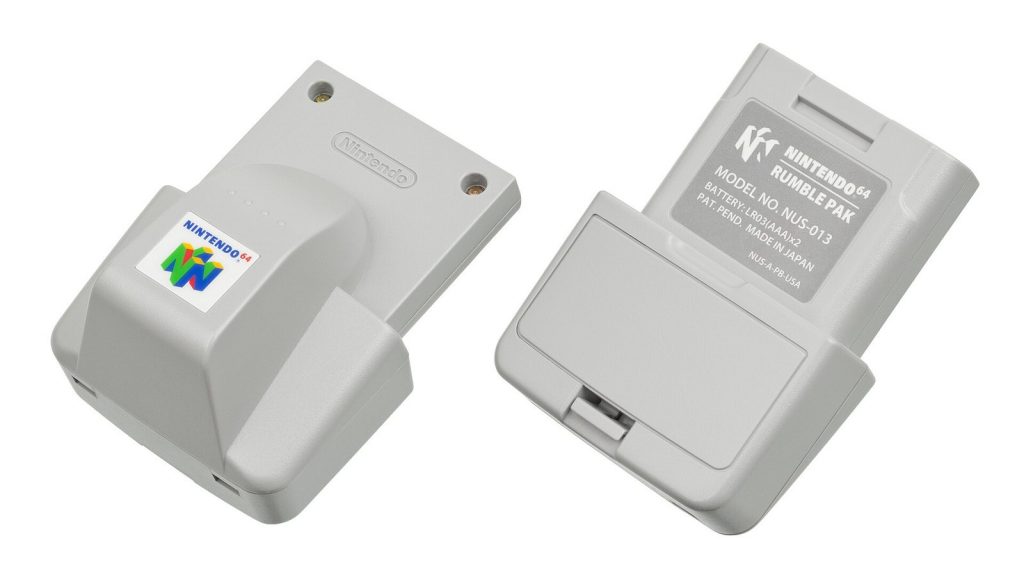
The most influential was the Rumble Pak. It launched in Japan on April 27, 1997, bundled with Star Fox 64 (released as Lylat Wars in PAL regions), and arrived in North America in July and Europe in October of that year. It ran on two AAA batteries and made the controller vibrate in response to on-screen events, such as explosions and collisions. Because it used the same slot as the Controller Pak, players sometimes had to swap accessories mid-game to save their progress.
Rumble quickly spread. As IGN later noted, it became an industry standard within a single generation, and force feedback is now a standard feature of almost every home console controller.
Four Controller Ports and the Multiplayer Living Room
Most earlier consoles had two controller ports; four-player games usually required an adapter. The Nintendo 64 had four ports built in, and that simple decision helped shape a generation of local multiplayer gaming.
Split-screen racing, party and battle games became a defining part of the console’s identity. The best-known example is Rare’s GoldenEye 007 (1997), whose four-player split-screen mode became a fixture of dorm rooms and sleepovers. The game sold over eight million copies, making it the third-best-selling N64 title, and it is often credited with showing that first-person games could succeed on consoles. Nintendo’s own racing and party games built on the same idea, turning the N64 into a social machine in a way few consoles before it had been.
The legacy is visible today: couch co-op and local multiplayer remain a central part of Nintendo’s design philosophy.
The 64DD: Japan’s Disk Drive Add-On
Nintendo did plan a way around cartridge limits. The 64DD was a magnetic disk drive that sat under the console and used rewritable disks holding 64 MB, with part of each disk writable for saving data. It was first announced in 1995, with a planned launch in late 1997 in Japan.
The 64DD was delayed repeatedly. Key games intended for it, including the next Zelda game, moved to cartridge instead. By the time it launched in Japan in December 1999, the Nintendo 64 was late in its life. It was sold through a mail-order bundle with Randnet, a dial-up online service limited to Japan. Only ten disks were released, including six games such as the Mario Artist creative software series. Nintendo announced the closure of the 64DD and Randnet in October 2000, and both were discontinued in February 2001. An American launch never happened.
Though a commercial failure, the 64DD was not without legacy. Mario Artist: Talent Studio let players create avatars from photographs, a concept reference sources link to the later Mii characters on the Wii.
Sales and Legacy
According to Nintendo, the Nintendo 64 sold 32.93 million units worldwide. North America accounted for the majority, with about 20.63 million units, compared with 5.54 million in Japan and about 6.75 million in Europe and Australia. That was well behind the original PlayStation, and well below the Super NES’s 49.10 million. Its successor, the GameCube, launched in September 2001, and the Nintendo 64 was discontinued in 2002.
Commercially, the cartridge decision was costly. Creatively, though, the Nintendo 64 had enormous influence:
- Analog control became a universal standard for 3D games.
- Controller vibration became expected on every major console.
- 3D camera systems designed for Super Mario 64 and later games became templates for third-person action.
- Four-player local multiplayer became a core part of console culture.
For collectors, the N64 is approachable. Cartridges are durable, loose games are common, and the console’s library is compact enough that a complete collection of standout games is realistic. Keep in mind that some games require the Expansion Pak, and that the console’s analog sticks can wear over time, so test controllers before buying. Many first-party games are also available through Nintendo Switch Online’s Expansion Pack, an easy way to revisit them today.