The Super Nintendo: History, Hardware and Why Its Library Endures
The Super Famicom and SNES: 1990–92 launches, Mode 7, Super FX and other enhancement chips, regional designs, and the non-RPG games that still hold up.
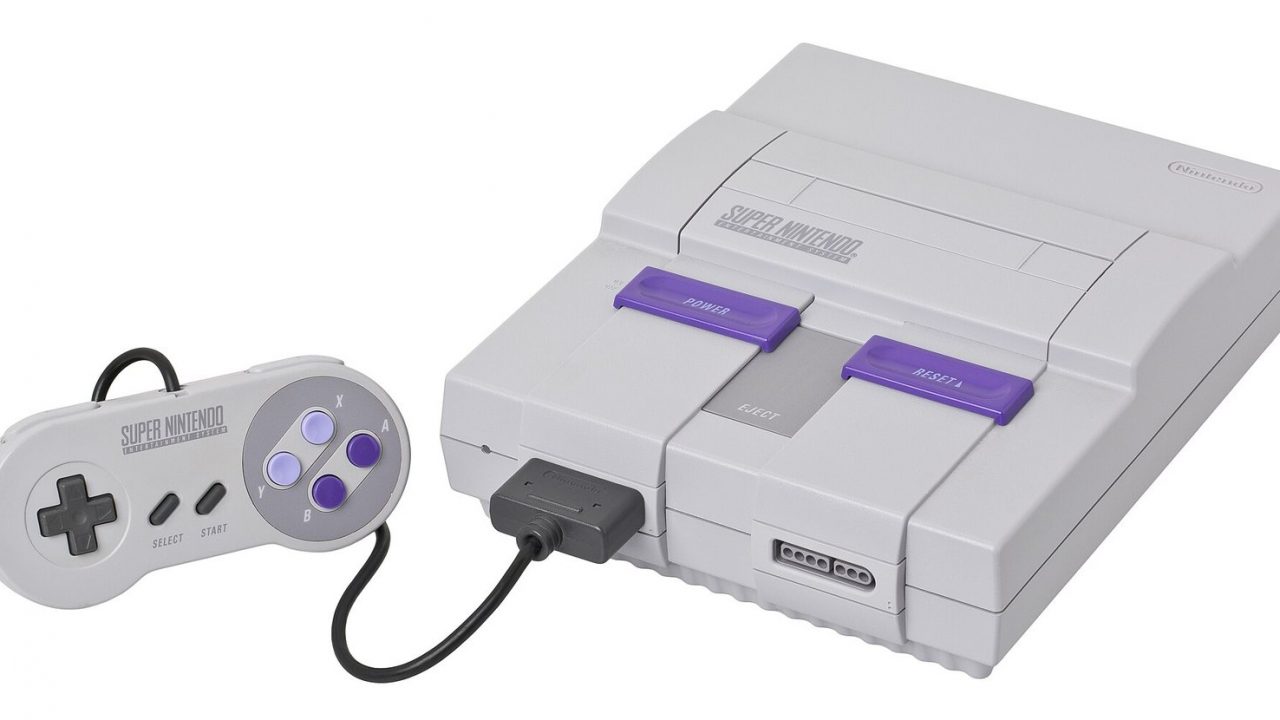
Nintendo was in no hurry to replace the Famicom. By the late 1980s, its 8-bit console dominated Japan and North America, and NEC’s PC Engine and Sega’s Mega Drive had already reached the market with more powerful hardware by the time Nintendo responded. When its 16-bit successor finally arrived, it was not the fastest machine of its generation, but it had a remarkable set of graphics and sound capabilities, a clever system for upgrading itself through cartridges, and a library that many players still consider one of the best ever assembled.
This article covers the launches of the Super Famicom and Super NES, the hardware behind Mode 7 and the Super FX chip, the distinctive regional designs, and the non-RPG games that best show why the library endures.
Launching a Successor
The Super Famicom launched in Japan on November 21, 1990, at ¥25,000. Like the original Famicom, it was designed by Masayuki Uemura. Its Japanese launch lineup was small, led by Super Mario World and F-Zero.
The Super Nintendo Entertainment System, or Super NES, followed in North America on August 23, 1991, priced at $199 and bundled with Super Mario World. Other early titles included F-Zero, Pilotwings, SimCity and Gradius III. Europe came later: France, the UK and Ireland received the console in April 1992, and the rest of Europe in June 1992.
By the time the Super NES reached the West, Sega’s Genesis had a two-year head start in North America, a story told in our history of the Sega Genesis / Mega Drive. The two consoles competed fiercely throughout the early 1990s.
The Hardware: Slower CPU, Stronger Graphics and Sound
On paper, the Super NES’s main processor was modest. Its Ricoh 5A22, based on the WDC 65C816 (a 16-bit extension of the 6502 family used in the NES), ran at a nominal 3.58 MHz, slower than the Genesis’s Motorola 68000. Its strength lay elsewhere.
| Component | Details |
|---|---|
| CPU | Ricoh 5A22 (65C816-based), nominal 3.58 MHz |
| Memory | 128 KB work RAM, 64 KB video RAM, 64 KB audio RAM |
| Colors | Up to 256 on screen from a palette of 32,768 |
| Resolution | Typically 256 × 224, with higher-resolution modes available |
| Sound | Sony-produced audio unit with SPC700 processor and 16-bit DSP, eight voices |
The large color palette gave Super NES games a richer, softer look than most competitors. The sound system was especially distinctive. It was designed by Ken Kutaragi and produced by Sony, and it played back sampled instruments rather than relying on synthesized tones. That allowed composers to approximate orchestral instruments, pianos and choirs, giving many soundtracks a lush quality. Kutaragi’s work on the chip was also the start of a Sony–Nintendo relationship that would later lead, indirectly, to the PlayStation, as explained in our history of the original PlayStation.
Mode 7: Rotation, Scaling and Fake 3D
The Super NES’s most famous graphics feature is Mode 7. It allows a single background layer to be rotated and scaled using a mathematical transformation. On its own, that lets a game spin or zoom a large image smoothly, which was impressive in 1990.
The real trick came from changing the transformation line by line down the screen. By scaling each horizontal line differently, a game could tilt the flat background into a ground plane receding toward the horizon. The result was a convincing pseudo-3D floor, with sprites drawn on top for cars, characters and objects.
Launch titles showcased the effect immediately. F-Zero used Mode 7 for its futuristic race tracks, and Pilotwings used it to simulate flight over landscapes. Super Mario Kart later built an entire franchise on the technique. Many other games used it more subtly, for rotating bosses, zooming title screens or world maps.
Mode 7 had limits. It worked on only one background layer, so the “3D” surface was always flat, and the illusion broke down at steep angles. True 3D polygons required something more.
Enhancement Chips: Upgrading the Console Through Cartridges
Because cartridges connect directly to the console’s internals, developers could add extra processors inside the cartridge itself. Several enhancement chips were used over the console’s life:
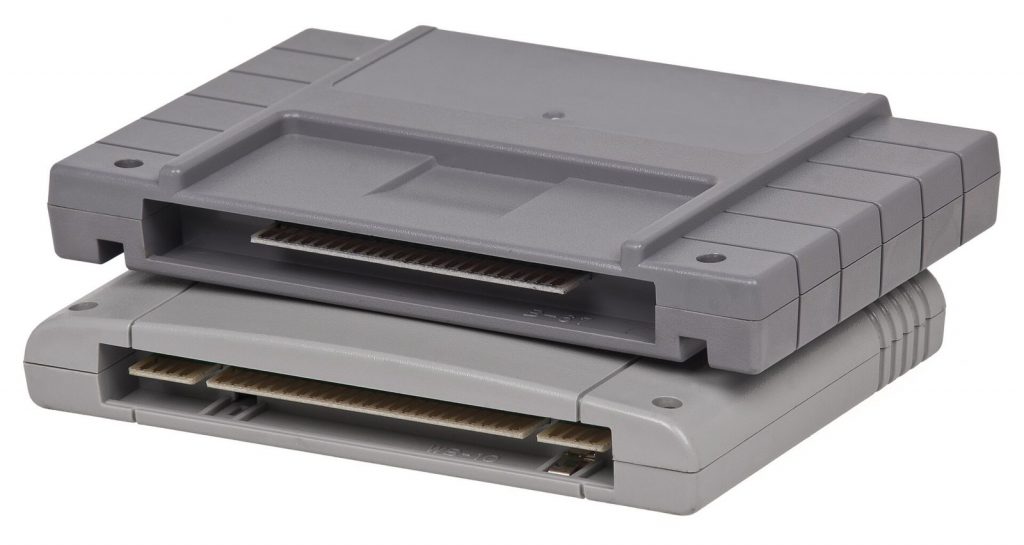
- Super FX: a custom RISC coprocessor designed by British studio Argonaut Games, which co-developed Star Fox (1993) with Nintendo. It allowed the game to render real 3D polygons, something the base console could not do. A later version, often called the Super FX 2, powered the 1995 Super NES version of Doom and was used for sprite scaling and stretching effects in Super Mario World 2: Yoshi’s Island. Only a handful of released games used Super FX chips.
- DSP chips: math coprocessors for calculations such as vector math and coordinate transformations. The DSP-1 was the most commonly used version.
- SA-1: a faster processor based on the same 65C816 architecture, running at about 10.7 MHz, used in later games that needed extra speed.
Super FX cartridges used extra contacts at the bottom of the board, which made them incompatible with some older pass-through accessories. For players, though, the chips meant that the console’s capabilities kept improving years after launch, without any new hardware purchase.
This approach had trade-offs. Enhancement chips raised manufacturing costs, which affected cartridge prices. Nintendo would wrestle with cartridge economics again in the next generation.
Regional Designs: Why the American SNES Looks Different
The Super NES is one of the few consoles that looks noticeably different depending on where it was sold. The Japanese Super Famicom and the European model share a more rounded, curved design. The North American Super NES has a boxy, angular case with purple sliding switches and a dark grey eject lever.
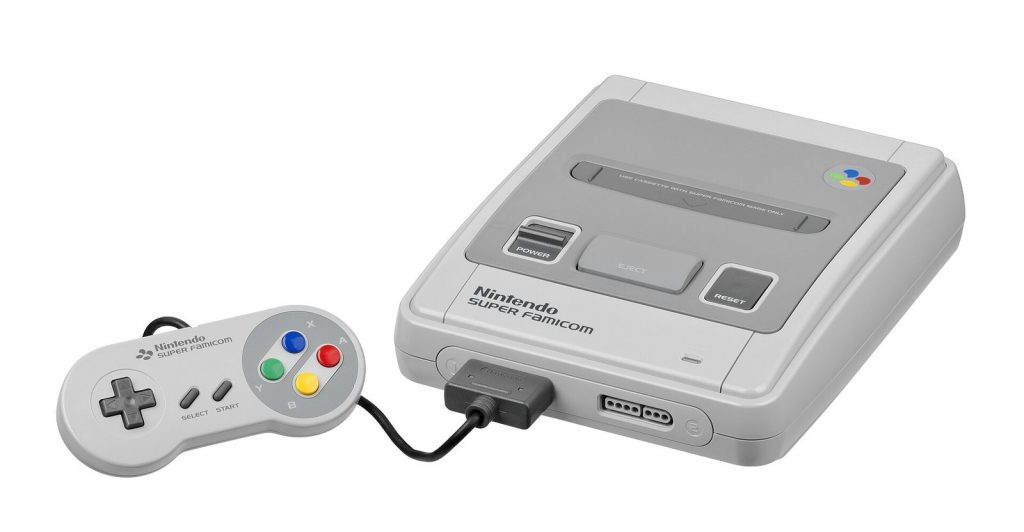
Late in the console’s life, Nintendo released a smaller, cost-reduced model in North America, the SNS-101, in October 1997, priced at $99.95 and bundled with Yoshi’s Island. Later cost-reduced revisions dropped some video output options, which matters to collectors seeking the best picture quality.
For collectors, the regional differences go beyond appearance. North American cartridges have a different shape from Japanese and European ones, and region locking prevents simply inserting imported games without an adapter.
Standout Non-RPG Games
The Super NES is famous for its role-playing games, but its action, racing and platform library is just as important. A few highlights:
- Super Mario World (1990): the pack-in for much of the console’s life and its best-selling game, at about 20.6 million copies. It introduced Yoshi and a world map packed with secret exits.
- F-Zero and Super Mario Kart: two racing games that showed what Mode 7 could do, the second founding a series that is still running.
- Star Fox (1993): the Super FX showcase that brought polygon 3D to a home Nintendo console.
- Donkey Kong Country (1994): developed by Rare, which rendered 3D models on Silicon Graphics workstations and converted them into detailed sprites. It sold about 9.3 million copies and was the fastest-selling game in history at its release.
- Street Fighter II: Capcom’s arcade hit became the console’s best-selling standalone game, at about 6.3 million copies.
- Super Metroid and The Legend of Zelda: A Link to the Past: exploration-driven action games regularly cited among the best of their kind.
- Yoshi’s Island (1995): a hand-drawn-style platformer that used the Super FX 2 for visual effects.
Buying a Super NES Today
A few practical points for anyone collecting the console now:
- Pick your model with video in mind. Earlier models offer more video output options through the multi-out port than later cost-reduced revisions, which is relevant if you plan to use RGB or an upscaler.
- Expect aging save batteries. Many larger games stored progress in battery-backed memory, and after three decades some of those batteries have run out.
- Check accessory compatibility. Super FX cartridges’ extra contacts mean some older adapters and pass-through devices will not work with them.
- Watch for reproductions. Popular and expensive titles are frequently reproduced. Our guide to spotting fake and reproduction games covers what to check.
Sales, Longevity and Discontinuation
According to Nintendo, the Super NES family sold 49.10 million units worldwide. Reference sources break that down as 23.35 million in the Americas, 17.17 million in Japan and 8.58 million elsewhere. That was below the original NES’s 61.91 million, but enough to make it the best-selling console of the 16-bit generation.
The console had a long tail. Nintendo discontinued it in Europe in 1998 and in North America in 1999, while the Japanese Super Famicom continued until September 25, 2003. One notable game did not make it out at all during the console’s life: Star Fox 2, a Super FX 2 sequel, went unreleased until Nintendo included it on the Super NES Classic Edition in 2017.
Why the Library Endures
Many Super NES games still feel modern in a way earlier games often do not. There are several reasons. Its sprite-based art has aged gracefully, because detailed 2D pixel art does not show its age the way early 3D does. Its controller introduced four face buttons and shoulder buttons, a layout that became the template for later gamepads. And it arrived at a point when developers had a decade of console experience and a capable but not overwhelming machine, so designers focused on polish and game feel.
For newcomers, the console is easy to explore today: original hardware is widely available, and Nintendo has re-released much of its first-party library through the Super NES Classic Edition and its online subscription service. Whichever route you take, the best of its library remains a benchmark for 2D game design.