The E.T. Atari Landfill: Separating Facts From Myth
Atari really did bury games in a New Mexico landfill in 1983. What the 2014 dig found, and what the famous E.T. legend gets wrong.

For decades, one of the most repeated stories in video game history went like this: Atari made a game so bad that nobody bought it, and the company buried millions of unsold copies in the New Mexico desert to hide its shame. The game was E.T. the Extra-Terrestrial for the Atari 2600, and the story became shorthand for everything that went wrong in the American games industry in the early 1980s.
Like many good legends, it mixes truth with exaggeration. Atari really did bury large quantities of games and hardware in a landfill in Alamogordo, New Mexico, in 1983, and a 2014 excavation confirmed it. But the burial was not only E.T., it was not “millions” of E.T. cartridges, and it was not a secret act of shame. This article separates what is documented from what is myth.
How E.T. Was Made: A Licence Deal and a Five-Week Deadline
In 1982 Atari was part of Warner Communications, and the success of Steven Spielberg’s film E.T. the Extra-Terrestrial made a game adaptation seem like an obvious holiday hit. Negotiations for the license concluded in late July 1982. The deal’s terms were not disclosed when it was announced, but later reports put the cost of the license at an estimated $20–25 million.
To have the game on shelves for Christmas, programmer Howard Scott Warshaw, who had already created Yars’ Revenge and the 2600 adaptation of Raiders of the Lost Ark, was given just over five weeks to design and program it. By the standards of the time, that was an extremely compressed schedule for a licensed flagship release. Warshaw delivered on time, and the game was released in North America in December 1982.
Two details from accounts of the deal show how unusual the project was. Atari’s CEO, Ray Kassar, reportedly called the idea of an E.T. game “a dumb idea” when Warner’s Steve Ross raised it. And Spielberg himself is said to have suggested something like Pac-Man; Warshaw chose a more ambitious adventure design instead, though he later acknowledged the suggestion might have had merit.
What the game actually is
E.T. is not a simple action game. The player guides E.T. through six environments, searching for three pieces of an interplanetary telephone hidden in wells (the infamous pits). An energy bar drains as E.T. moves, falls or uses his powers; Reese’s Pieces restore energy, and collecting enough lets E.T. call his friend Elliott for help. A scientist and an FBI agent chase E.T. around the map. After assembling the phone and calling home, the player must reach a landing zone before time runs out.
The pits are the game’s most criticized feature. Players frequently fell into them, often accidentally, and climbing out was slow and awkward. For many players unfamiliar with the instructions, the game felt confusing and repetitive.
Sales, Returns and Reputation
It is often said that E.T. did not sell, but that is not accurate. Reference accounts based on contemporary figures report that E.T. sold over 2.6 million copies by the end of 1982, which would make it a commercial hit by most standards. Warshaw himself has pointed out that it was “a million seller.”
The problem was the size of the bet. Atari produced about four million cartridges, and the company’s then-CEO, Ray Kassar, later said that roughly 3.5 million of them came back as unsold inventory or returns. At least 669,000 copies were reported returned in 1983 alone. Atari had made far more than it could sell after an expensive license, and many buyers who did purchase it were disappointed.
Since then, E.T. has appeared at or near the top of numerous “worst game ever” lists, including Electronic Gaming Monthly‘s list of the 20 worst games. Critics commonly link its problems to the impossibly short schedule. Not everyone agreed, though: some contemporary reviews were positive, and later reassessments have argued that the game is more playable once its rules and the pit mechanics are understood. Hobbyists have also studied the game closely: an annotated disassembly of its code was published in 2006, and in 2013 a programmer released unofficial fixes that, among other things, made it much harder for E.T. to tumble into pits by accident.
The Bigger Picture: E.T. and the Crash
E.T. is often blamed for causing the North American video game crash, but historians generally treat it as a symptom rather than the cause. The market was already suffering from too many consoles, a glut of low-quality games from many publishers, competition from home computers and heavy price-cutting by retailers. Several academic and popular histories note that the industry was already declining before E.T. arrived. Atari’s own Pac-Man port for the 2600, produced in enormous numbers earlier in 1982, is another frequently cited example of overproduction.
For a full explanation of those forces, see our explainer on the video game crash of 1983. For the console that both E.T. and Pac-Man were made for, see our Atari 2600 history.
The 1983 Burial in Alamogordo: What Was Reported
In September 1983, Atari trucks began dumping material at a landfill south of Alamogordo, New Mexico. Contemporary reports said the material came from Atari’s plant in El Paso, Texas, which was being closed. Importantly, the dumping was not hidden: it was reported in the press at the time, and local residents noticed it.
The burial included unsold cartridges, consoles and computer equipment. Atari’s stated explanation was that it was shifting from 2600 games to games for its newer Atari 5200 console, although a worker disputed that account. An Atari official described the material as “by-and-large inoperable stuff.” The crushed material was covered, and starting September 29, 1983, concrete was poured over it. Local officials objected to the dumping, and it was soon halted.
Over the following years, the story was retold and simplified. In many versions, the burial consisted entirely of E.T. cartridges, numbered in the millions, and was carried out secretly. Because the site was under concrete and nobody had dug it up, the story drifted into the status of an urban legend, with some people doubting it had happened at all.
The 2014 Excavation and Atari: Game Over
In 2014, a production effort involving Fuel Industries, Microsoft’s Xbox Entertainment Studios and others obtained permission from New Mexico and Alamogordo officials to excavate the site. The dig took place on April 26, 2014, and attracted a crowd of fans and media. Howard Scott Warshaw attended, as did author Ernest Cline and filmmaker Zak Penn.

Penn directed the resulting documentary, Atari: Game Over, released by Microsoft on November 20, 2014, through Xbox platforms and later made available on other services. The film covers both the dig and the story of E.T.’s development, with interviews including Warshaw, Atari co-founder Nolan Bushnell and others.
What was actually found
The excavation confirmed that Atari games were buried at the site. The team recovered about 1,300 cartridges, representing dozens of different titles: reports describe 59 games, mostly for the Atari 2600, with a handful of Atari 5200 titles. Copies and packaging of E.T. were there, but so were many others, including Centipede, Yars’ Revenge, Star Raiders, Pac-Man, Space Invaders, Defender and Warlords. Much of the material lay deeper than the excavators could reach.
James Heller, the former Atari manager who had overseen the 1983 burial, said the total had been about 728,000 cartridges across many games. That is consistent with earlier statements by Atari officials putting the number at roughly 700,000.
Where the cartridges went
About 100 artifacts went to the documentary producers, and some were given to museums, including the New Mexico Museum of Space History and the Centre for Computing History in England. The city of Alamogordo approved an auction of recovered cartridges in 2014. As of April 2025, sales of roughly 880 cartridges had raised more than $107,000, with one E.T. copy selling for more than $1,500. The proceeds went to city public works and the Tularosa Basin Museum of History.
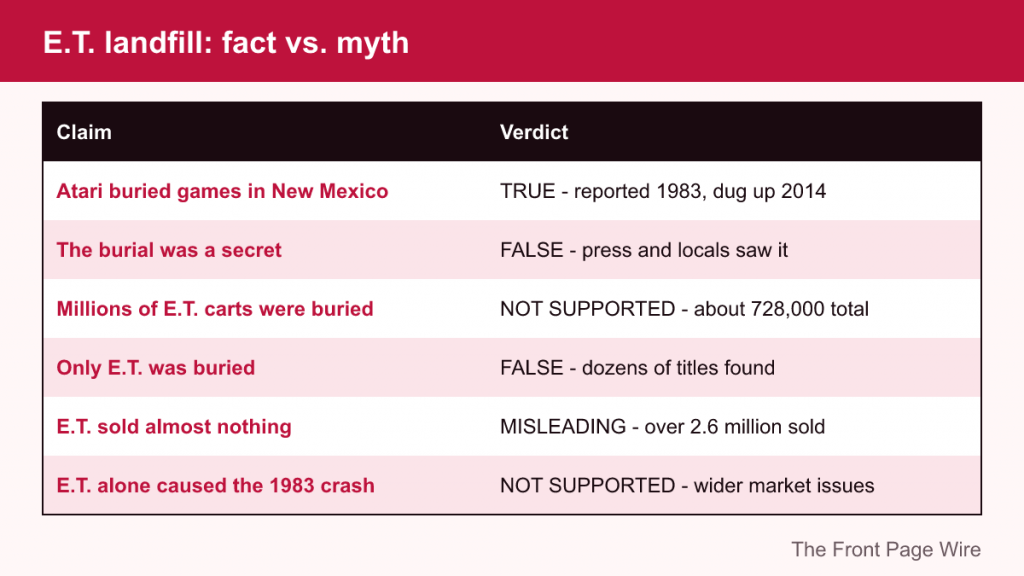
Fact vs. Myth: A Quick Reference
| Claim | Verdict |
|---|---|
| Atari buried games in a New Mexico landfill. | True. It was reported in 1983 and confirmed by the 2014 dig. |
| The burial was a secret. | False. It was covered by the press and noticed by locals at the time. |
| Millions of E.T. cartridges were buried. | Not supported. The former Atari manager in charge put the total at about 728,000 cartridges of many titles. |
| Only E.T. was buried. | False. Dozens of titles were recovered, plus hardware was reported in 1983. |
| E.T. was a commercial flop that sold almost nothing. | Misleading. It reportedly sold over 2.6 million copies, but Atari overproduced and received huge returns. |
| E.T. alone caused the 1983 crash. | Not supported. The market was already in trouble for broader reasons. |
Why the Legend Endured
The E.T. landfill story is memorable because it is a perfect metaphor: an expensive Hollywood license, a rushed product, and the physical evidence buried in the desert. It condensed a complicated economic collapse into a single image. That is exactly why historians caution against it. Blaming one game and one programmer obscures the decisions by management to overproduce, the flood of competitors and the business conditions that made the crash possible.
Warshaw’s own reputation has also been reassessed. Many accounts now emphasize that he was given an almost impossible deadline, and IGN’s Levi Buchanan argued that the schedule absolves him of blame. Warshaw has said he does not regret making the game.
A Footnote on Preservation
The dig also illustrates something about how games survive. The cartridges recovered from Alamogordo became museum objects not because they were rare (E.T. was manufactured in the millions) but because of their story. Context, documentation and provenance can matter as much as the object itself, a theme that runs through modern game preservation work, which we discuss in why video game preservation matters.