How Light Guns Worked: The Zapper, Duck Hunt and the CRT Connection
Light guns never fired light. Here is how the NES Zapper and arcade guns read a CRT screen, and why the classic ones fail on modern flat-panel TVs.
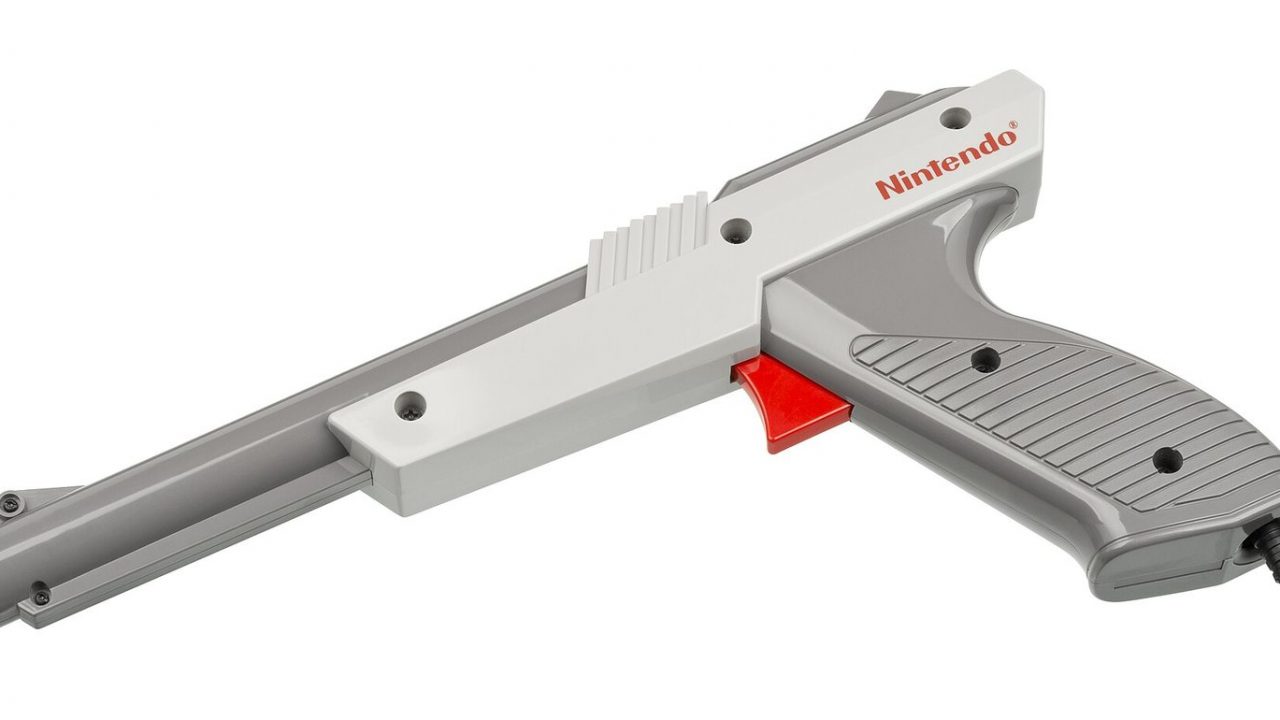
For anyone who grew up with an NES, the orange or gray Zapper and the laughing dog of Duck Hunt are instantly familiar. What fewer players realized at the time is that the gun did not shoot anything at the screen. A light gun is a receiver, not a transmitter: it contains a light sensor, and the trick is entirely in how the game and the television cooperate to tell that sensor what it is looking at.
That trick depended on the way cathode-ray tube (CRT) televisions drew their pictures, which is why classic light guns stopped working when households switched to flat panels. This article explains the main detection methods, the history of light-gun games from electromechanical arcades to Time Crisis, and what changed with modern displays.
A Brief History: From Electromechanical Ranges to Video Games
Shooting games with light-sensing guns are older than video games. After light-sensitive vacuum tubes were developed, arcade manufacturers began building gun games in the 1930s; the Seeburg Ray-O-Lite of 1936 is generally cited as the first arcade shooting game to use the technology. Players aimed at moving targets that carried light sensors, and a hit registered when the gun’s beam reached them. In other words, those early guns really did emit light.
Video games reversed the arrangement. When the image is generated on a screen, the screen itself becomes the light source and the gun becomes the sensor. The Magnavox Odyssey, the first home video game console, offered a Shooting Gallery accessory in 1972. Nintendo, long before its consoles, sold light-gun toys and arcade attractions in Japan during the 1970s, including the Beam Gun toy line and Wild Gunman (1974), which used projected film footage as its target.
How a CRT Draws a Picture
To understand light guns, you first have to understand the display they were designed for. A CRT television does not show a whole picture at once. An electron beam sweeps across the screen from left to right, one horizontal line at a time, working from top to bottom, and the phosphor coating glows where the beam strikes it. In the NTSC standard used in North America and Japan, the screen is redrawn about 60 times per second.
Two properties of that process made light guns possible:
- The timing is fixed and real-time. The console generates the video signal, and the CRT draws it immediately, with essentially no processing delay. The console therefore knows, at any instant, which part of the screen is being drawn.
- Brightness changes instantly. If the game changes a frame from black to white, the screen goes from dark to bright on the very next refresh.
A light gun contains a light-sensitive component, typically a photodiode, behind a lens in the barrel. The lens narrows the sensor’s view to a small area of the screen roughly where the barrel is pointing. On its own, the sensor reports only whether it currently sees light. Games used two main strategies to turn that very limited information into a hit or a miss.
Method One: The Zapper’s Black Screen and White Boxes
Nintendo’s light gun for the Famicom launched in Japan in February 1984 alongside Wild Gunman, and the NES Zapper arrived with the console’s North American launch on October 18, 1985. It used what can be called the sequential-target method, described in Nintendo’s patent and in standard references.
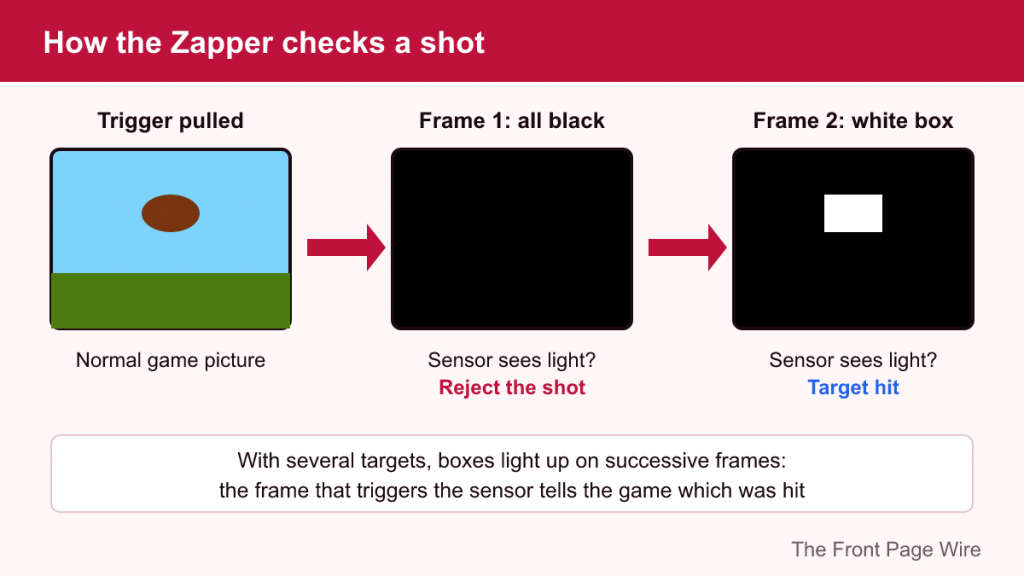
- When the player pulls the trigger, the game blacks out the entire screen for one frame. If the sensor sees light during this frame, the gun is not pointed at a target, or is pointed at some other light source, so the shot can be rejected.
- On the next frame, the game draws a solid white box where each valid target is, with everything else black.
- If the sensor now sees light, the gun was pointed at a target.
- When there are several targets, the game can light them up one after another on successive frames, and the frame in which the sensor responds tells the game which target was hit.
All of this happens within a fraction of a second, so to the player it looks like a brief flicker. In Duck Hunt the white boxes stand in for the ducks, and in two-duck mode the game identifies which bird was hit by the order of the flashes. Because the reference black frame rejects shots taken with the gun pointed at a lamp or a window, the method is reasonably robust against simple cheating, though games still had to take care against bright light sources.
The launch games
Three Zapper games launched with the NES in North America in 1985: Duck Hunt, Hogan’s Alley and Wild Gunman. Duck Hunt was also bundled with the Zapper in NES sets, which is why it became one of the most familiar games of the era. You can read more about the console’s launch in our NES and Famicom history.
Why the Zapper changed color
The original North American Zapper had a dark gray body designed to match the console. Later Zappers were produced with a bright orange body, and standard references connect the change to US federal rules requiring toy guns to be clearly distinguishable from real firearms.
Method Two: Reading the Beam Position
The second approach uses the timing of the electron beam directly. When the trigger is pulled, the game makes the screen bright, and the console’s video hardware notes the exact moment the sensor first detects light. Because the beam’s position at any instant is known, that moment corresponds to a specific line and horizontal position on the screen. This gives the game actual coordinates rather than a yes-or-no answer for a predefined target, so it is suited to games with crosshairs or free aiming.
This method requires faster sensors and video hardware that can latch the beam position at the right moment. Sega’s Light Phaser for the Master System (1986) and Nintendo’s Super Scope for the Super NES (1992) are examples of guns designed for position-based play, as is the light-pen technique used on some home computers. Namco’s GunCon for the PlayStation, released in 1997 alongside the home version of Time Crisis, brought precise light-gun play to the 32-bit generation.
Arcade Light Guns: Operation Wolf and Time Crisis
Arcades took light guns further than home consoles could, because the gun could be built into the cabinet. (For the bigger picture of the arcade business, see our golden age of arcades overview.)
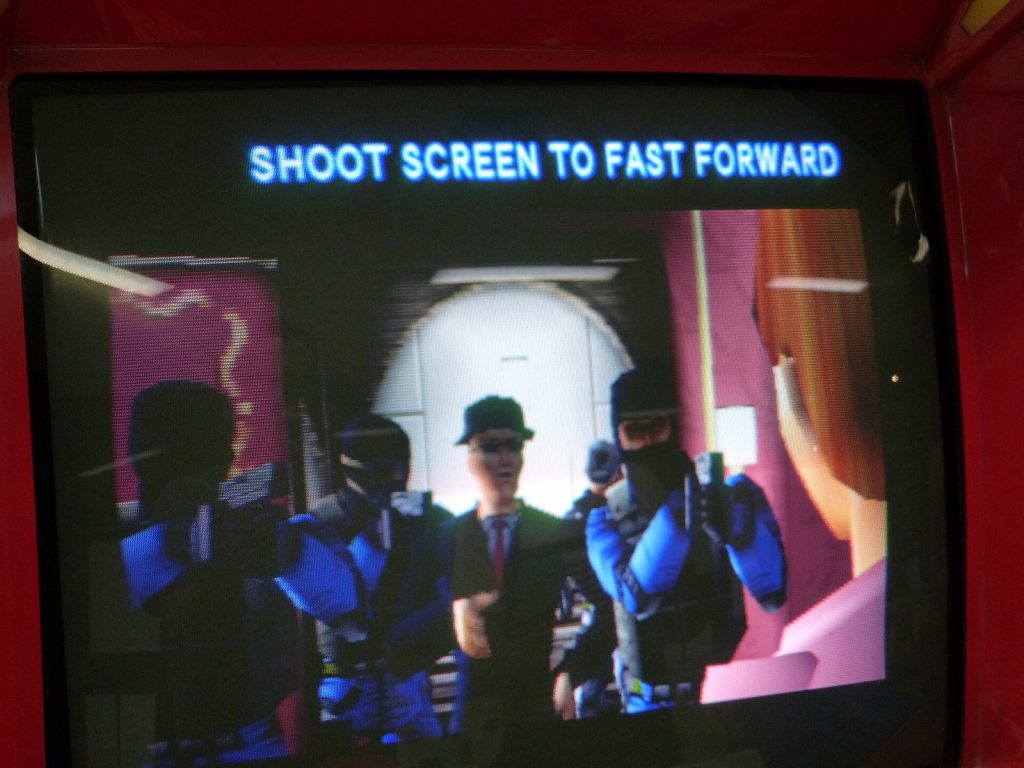
Mounted guns versus free guns
Arcade guns fall into two broad categories. Positional guns are mounted on a swivel and work like analog joysticks: the cabinet measures the angle the gun is pointing and draws a crosshair accordingly. They need calibration but are durable and easy to maintain. Optical light guns use a sensor and the screen-timing techniques described above, and do not know where they are pointing until fired.
Operation Wolf (1987)
Taito’s Operation Wolf was released in arcades in 1987. Its cabinet featured a mounted gun shaped like an Uzi submachine gun that could be swiveled and raised, vibrated to simulate recoil, and fired automatically while the trigger was held, with a separate button for grenades. Despite its mounted design, the gun was an optical controller with a sensor inside. The game was a critical and commercial success; it was reported as the top-earning arcade game of 1988 in the UK and among the five highest-grossing dedicated arcade games of 1988 in the US. Taito followed it with Operation Thunderbolt in 1988.
Time Crisis (1995)
Namco’s Time Crisis arrived in arcades in December 1995 on Namco’s Super System 22 hardware. Its key innovation was a foot pedal: pressing it made the player’s character leave cover to shoot, and releasing it ducked behind cover to reload and avoid fire. That simple mechanic turned an on-rails shooter into a game about timing and risk. The arcade gun also included a blowback feature for recoil. The PlayStation version in 1997 replaced the pedal with a button and came bundled with Namco’s GunCon. The series continued with Time Crisis II and later sequels.
Why Classic Light Guns Don’t Work on Modern TVs
Classic light guns rely on the assumption that the image appears on screen at the exact moment the console sends it. Modern flat-panel televisions break that assumption in several ways:
- Processing delay. LCD, OLED and plasma TVs buffer and process the incoming signal (scaling, deinterlacing, image enhancement) before displaying it. Even a small delay means the bright frame appears after the game has already checked the sensor, so the game concludes the shot missed.
- No scanning beam. Methods that infer position from beam timing have nothing to measure on a fixed-pixel display, which does not draw the image with a single sweeping beam in sync with the console.
- Upscalers add their own lag. External devices that convert retro signals for HDTVs, discussed in our guide to connecting retro consoles to modern TVs, can add further delay.
This is why light-gun games are one of the strongest reasons collectors keep a CRT television around. Plugging an original Zapper into a flat-screen TV usually produces nothing but misses.
Modern Alternatives
Later systems moved away from screen timing entirely:
- Infrared tracking. The Wii Remote uses an infrared camera that tracks a sensor bar placed near the TV. It works on any display but requires calibration and has been described by some reviewers as less precise than a traditional light gun. Namco’s GunCon 3, used for the PlayStation 3 version of Time Crisis 4, also uses infrared.
- Screen-outline detection. Some modern aftermarket guns use a camera to detect the rectangular outline of the screen and calculate where the gun is pointing from its shape and distortion. The Sinden Lightgun introduced this method.
None of these make an original Zapper work on a flat panel, but they let the genre continue on modern displays.
Common Myths About Light Guns
“The gun shoots a beam at the screen.” Not for video game guns. The screen is the light source; the gun is a sensor.
“Any light gun works on any console.” Different consoles use different connectors and detection methods. The Zapper, Light Phaser, Super Scope and GunCon were each designed for specific hardware.